
Red Agate — the colour you wear for yourself
Ember Quiet Mineral Series · Red Agate
Red gets there first
Hold a red agate bead at arm's length and it still reads as red. Move it to the edge of your vision, almost out of sight, and it is still red there.
That is not a decision you make. Red travels a faster pathway in the retina than any other colour, and at the edge of your vision a red point registers before a blue one of the same size. The priority is built in, and it takes effect before you have looked at anything.
Which explains a great deal about the world you walk through. Stop signs. Brake lights. The stripe on a siren. Warning colour on animals that would rather you kept your distance. Every one of them is borrowing the same fact about your eye.
It also explains why red was the first colour anyone bothered to make. Not because it was easy. Because it worked at a distance, on a stranger, before any words had been exchanged.
That is worth sitting with. The whole history of red is a history of being seen.
What they used it for, and what we use it for
Start with the oldest use. Red ochre, ground and mixed with fat, pressed into the skin of someone about to be looked at by a group. A hundred thousand years of that, wherever the ground gave up the colour.
Then the expensive ones. Cinnabar, which had to be dug and heated, and which killed the people who worked it. Cochineal, harvested by hand in Mexico in numbers that are hard to picture, worth more by weight than gold for a stretch. Both went onto things made to be seen by other people: a wall, a robe, a face.
Every use had the same audience. Someone else.
Which is the part that no longer applies. Nobody needs a colour to announce that they are here. The announcement is handled all day by everything that lights up.
So the question changes. If red is not doing that job any more, what is left for it?
We think it turns around.
Worn now, red is not a signal to a room. It is a signal to the person wearing it.
Three situations make that useful, and none of them is dramatic.
The first is the ordinary one. The same commute, the same screen, the same grey month, a routine that has quietly lost its colour. Nothing is wrong. Nothing is vivid either.
The second is the flat stretch, where nothing you do seems to land and the days stop having edges.
The third is the opposite, and easier to miss: a stretch that is going well, where you have been running for so long that you have stopped remembering why you started.
In all three, what is missing is not energy. It is a reminder.
A small red thing on your wrist does not fix any of that. What it does is break the surface. Your eye finds it before it finds anything else, which is the one thing red is better at than any other colour, and for a second you are looking at something that is not the screen.
That second is the whole product. Which piece you put there is what the next section is about.
What red agate is
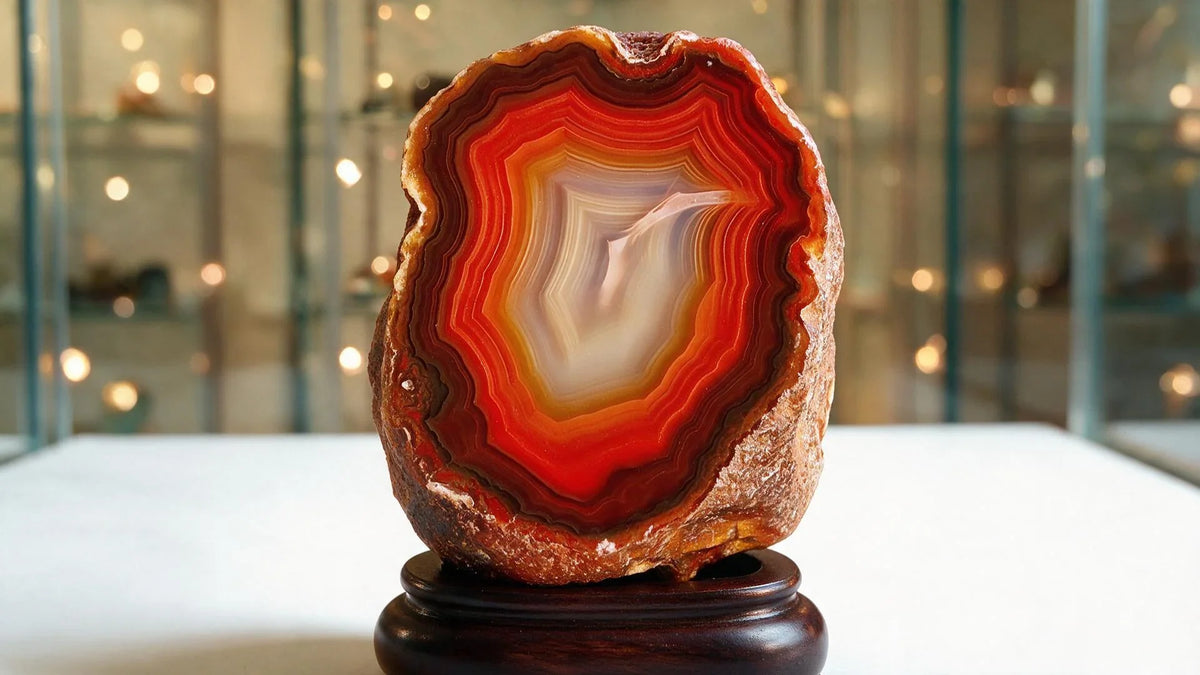
Red agate is chalcedony: quartz so fine-grained that no crystal can be seen, carrying iron oxide through it.
Hold a bead up to a window and the light goes through. What you see inside is the growth: fine parallel lines, sometimes curved, following the shape of the cavity it filled and then hardened in. The colour sits in the iron, not in a coating, which is why the lines and the red are in the same place rather than one sitting on top of the other.
That red is why Egypt cut it into the tjet knot, the amulet that stood for Isis, often in carnelian rather than in any other red stone. The museum that holds the best of them notes that the colour may allude to her blood. It is one line of description, not a doctrine, but it is the oldest explanation anyone wrote down for choosing this stone in this colour.

Three times we have paired it, and each pairing changes what the red is doing.
Three red agate bracelets, three different jobs
Luminous Pulse is clear quartz and red agate, with the red placed at intervals through the strand.
The clear quartz is the idea. It is transparent, it throws light back, it reads as bright and uncommitted. The red is the part with weight. Arranged that way, the strand becomes a sequence rather than a surface: light, weight, light, weight. Every clear bead moves your eye on. Every red one holds it for a beat. In daylight the clear beads nearly disappear, and what you see is a line of red with gaps in it.
Which is the piece for the gap between deciding to do something and doing it. The morning you write the plan. The hour before a task you have been putting off for a week. The first day back on a project that stalled in the spring.
It does not make the task easier. What it does is stop the gap from being invisible. You look down, there is a red bead, and the bead is not the plan.

Resilient Bloom pairs the red with malachite, and it is the only one of the three where the red is not the subject.
Malachite is banded green, arcs inside arcs, and it takes up most of the strand. The red sits in the intervals between it. What the red does here is temperature. Green on its own reads cool, and a cool green in a piece about coming back from something reads like endurance rather than recovery. The red is what keeps it from going cold.
It is the piece for the season after an ending. The first weeks of a new job. The month after a move, when the boxes are still stacked in the hall. The stretch where you have started something and it has not yet become a habit, and the only thing keeping it going is that you keep showing up.
That is the hardest stretch to wear something for, because nothing is visible yet. The red here is small and it is not the point, which is exactly why it works. It is warmth in the middle of a process, not a headline.
Velvet Fire is the one where red takes the lead. Red agate and rose quartz, alternating, one of each, the whole way round.
Red is the fire. Rose quartz is the velvet: opaque, soft pink, no flash in it at all. They take turns, so the fire never gets to stand alone and the softness never gets to settle into anything. The piece is the arrangement, not the list of stones. It is the warmest of the three and the one with the most contrast, because the two stones are doing opposite things at the same time and neither of them wins.
It is for the moments that ask you to be both. A decision you have been circling for months. The first time you do something. A conversation where you have to say the true thing rather than the easy one.
What it is not is armour. The whole point of the pairing is that you do not have to choose between being warm and being forward. Most of what tells you otherwise is advice from people who found one of the two easier.

Three bracelets, three different jobs, and the same single action: you look down, and something red is there.
All three are in the red agate collection, where the three pairings sit side by side. This page is for the stone.
None of that is a claim about what the stone does. The colour is a reminder, and a reminder only works if it arrives at the moment you need it. A wrist is a good place for that, because you already look at your hands all day.
What was done to red agate
Red agate properties, in the plain physical sense, come down to two numbers: hardness 6.5 to 7 on the Mohs scale, and a specific gravity of about 2.6. That makes it essentially the same as quartz, and one of the durable stones here. It will not mark against a key, and it can be worn every day without much thought.
Then the part that has to be said plainly. Most vivid red agate on the market has been heated, and ours has. Agate comes out of the ground orange or brown. Hold it at 400 to 450 degrees Celsius and the iron inside it changes state, and it comes out red.
No pigment. No dye. No additive. Heat, and nothing else.
What happens is narrow and specific. The stone starts as chalcedony carrying iron in a hydrated form, mostly limonite, which is yellow-brown and gives unheated agate its honey tones. At that temperature the limonite loses its water and converts to hematite, which is red. The quartz framework is left alone. No colour centre is created, and nothing is introduced from outside. What left was water.
That is why the temperature can be so low. A change that needed new crystal growth would take far more heat. This one is a change in hydration state, and it happens in an ordinary kiln.
The practice is not new either. The bead workshops of Khambhat in India have been working this material since the Harappan period, and the town is still one of the largest bead-making centres in the world. Five thousand years in the same place, doing the same thing to the same stone.
Set that beside what cinnabar and cochineal required. Warming a stone until the iron already inside it changes state is the gentlest thing anyone has ever done for this colour.
So when a listing says heated, it describes a change of state rather than an addition. The iron was already there. The banding was already there. The modern part is the thermostat.
Questions about red agate
Is red agate the same as carnelian, and why do shops use both names?
Mineralogically both are chalcedony coloured by iron oxide. Carnelian usually means the clear red-orange material, agate the banded kind, and most stones sit between the two. The names were never fixed and no authority decides which is right. Ours is sold as red agate because the banding is the point of it.
What is the meaning of red agate?
Not something the stone carries by itself. The meaning came from what people asked of red long before this stone had a name: warm a room, mark a border, say that something matters. The colour did the work first, and the stone inherited it.
Is your red agate natural or heated?
Heated, and we say so. The banding is natural, the material is agate and not glass, and nothing has been dyed or added. Heating changes the state of iron that was already in the stone.
Is red agate a birthstone?
Yes, for July, where it is sold under the other of its two names: July birth month crystal. All three pieces on this page take a month crystal, and any of them can carry July's stone in our personalized collection.
Does red agate fade?
No. The colour comes from iron oxide rather than from a colour centre that light can break down, so it holds in a window the way amethyst does not.
How hard is red agate?
6.5 to 7 on the Mohs scale, about the same as quartz. It resists scratching well and can be worn daily without much attention. See our crystal bracelet care guide for daily habits and storage.
Is red agate dyed?
No. Dyed agate has colour sitting in cracks and between grains, and it looks flat under a loupe. Heated agate has colour inside the iron itself, which is why the bands in ours vary in tone rather than sitting on top of the surface.
Which red agate bracelet should I start with?
Velvet Fire if you want the red to be the subject. Luminous Pulse if you want it working underneath something clearer. Resilient Bloom if you want it doing the quietest job of the three, warming a green that would otherwise read cold.
Ember Quiet. The ember is what the earth leaves. The quiet is what you do with it.