
Article: Lapis Lazuli — the farthest blue you can wear
Lapis Lazuli — the farthest blue you can wear
Ember Quiet Mineral Series · Lapis Lazuli
The only blue you can hold
The sky is blue for most of the hours you are awake, and you cannot touch it. The sea is blue at a distance and clear in your hand. Every other colour you can pick up and hold against something. Blue is the one that stays out there, at the far end of the view, where you can see it and not reach it.
Which is why the colour carries two things at once: the pull of something beautiful, and the quiet suspicion that it is not for you.
Lapis lazuli is the exception. It is the blue that came indoors.
Lapis lazuli history: the eye before the throat
Most shops that sell it today will tell you it belongs to the throat. Expression. Speaking your truth. Some add the third eye, and mention intuition.
That reading is not wrong, and it is not old either. It arrived with the twentieth century, along with most of what is now said about stones and chakras.
Egypt had this stone three thousand years before that, and gave it a different job.
In Egyptian myth, the sun god had skin of gold and hair of lapis lazuli. That one line says more than any modern description, because it tells you where the blue sat: not on the god as an ornament, but in him, as part of what he was made of.
People wore it for the same reason. Small pieces of lapis were strung and carried, the same stone the god had in his hair. If the blue was part of what a god was made of, then wearing it was the closest a person could get to standing beside one.
Then there is the eye.
Egyptian craftsmen had gold, carnelian and turquoise to work with, and they used all of them. But when the object needed to see, they reached for lapis.
On the gold mask of Tutankhamun, the eyebrows, the heavy lines that sweep back toward the ears, and the outline around each eye are not paint. They are cut from Afghan stone and set into the gold. Everything else on that face is gold. The blue is where the eyes are.
The jewellers made the same choice at a smaller scale. On the wedjat, the eye of Horus, the pupil and the outline were set with lapis, and the same pairing turns up on amulets and on small objects people carried.

In the place and the period where this stone was most expensive and most controlled, it was used for eyes.
Which raises the question the shops never ask: why does this blue belong to the eye?
Three thousand years and a change in what mining costs later, the same stone sits on a wrist for the price of a meal. The blue did not change. The access did.
Why lapis lazuli is blue
Lapis lazuli properties, in the plain physical sense, come down to two things: it is a rock rather than a single mineral, and the blue in it comes from sulphur rather than from a metal.
In most blue stones the colour comes from a metal. Sapphire is blue because iron and titanium trade an electron back and forth inside the crystal. Azurite is blue because of copper. Lapis is neither. Its blue comes from a small cluster of three sulphur atoms held in the lattice, and it is one of the most efficient colouring agents in the mineral world: a piece needs only about one of those clusters per hundred formula units to come out a deep, saturated blue.
Almost nothing else in the ground behaves this way. There are several hundred green minerals and only a few dozen that are reliably blue. Blue is the part of the visible spectrum that materials are least likely to throw back at you.
Which is why, for most of recorded history, one stone supplied it.
Then there is what blue does to the eye, which is the other half of the same story.
The people who put lapis around a pair of eyes were not measuring wavelengths. But they were choosing the one stone that does something no other blue stone does: it asks the eye to look past what is immediately in front of it.
Blue light focuses slightly in front of the retina rather than on it. That is not a defect; it is what short wavelengths do when they pass through a lens. The consequence is small and constant: to bring blue into focus, the eye has to relax a little, and relaxing the lens is exactly what it does when it looks at something far away.
So the colour that was hardest to own is also the colour that makes the eye behave as if it is looking at a distance.
And the stone itself is not a wall of blue, which is the first thing anyone notices when the beads arrive.
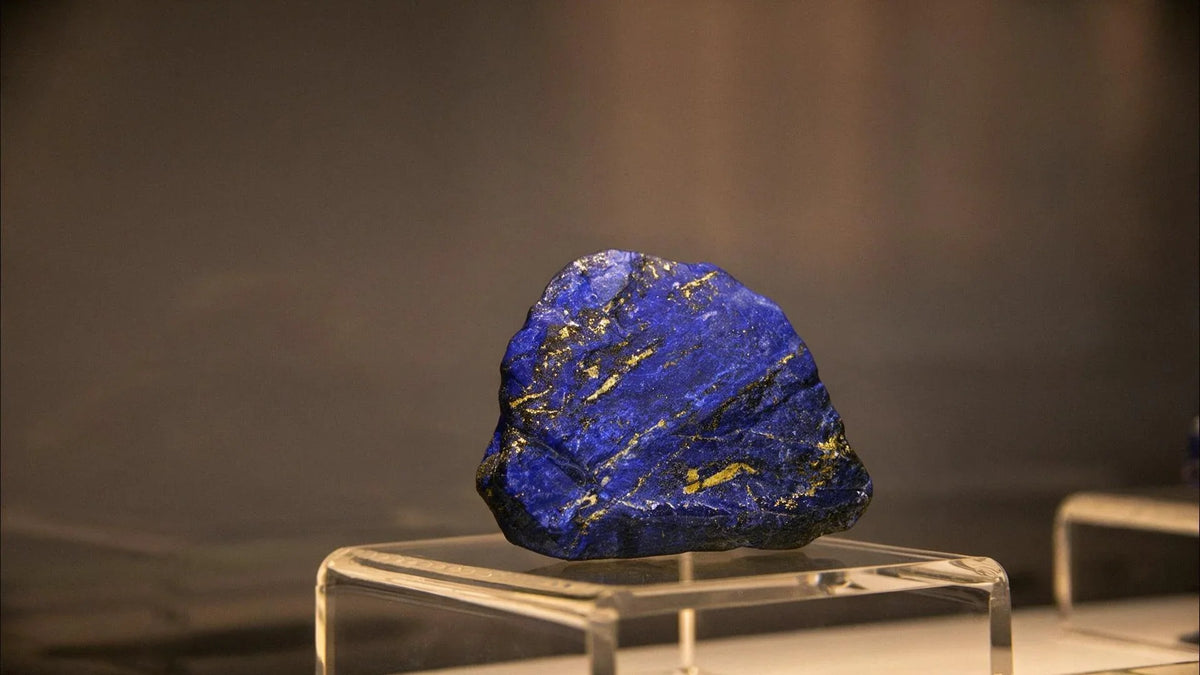
Lapis is a rock, not a crystal, and three minerals grew into it together. The blue is lazurite. The white lines are calcite, and they run through the stone the way clouds sit in a sky. The gold dots are pyrite, small mirrors that catch a light the blue does not.
Higher grades have less of both. Plenty of people prefer the ones that have more, because gold on deep blue is the most recognisable thing this stone does. Neither reading is wrong, and we would rather you knew what you were looking at than be told which one is better.
Put the two together and the stone stops being a decoration. It is the rarest blue anyone could hold, and it is the one that asks the eye to look further than the thing in front of it. Not a colour. A distance.
Lapis lazuli bracelets: True North and White Space
There are two ways to lose your sense of direction, and they need different things.
True North
True North is a hematite and lapis lazuli bracelet, and the two stones do separate jobs.
The hematite is the anchor. It is the heaviest stone we work with, twice the weight of quartz for the same volume, and it sits low on the wrist. Polished, it is a mirror: it throws back the room instead of holding a colour of its own, which is why a hematite bead looks different depending on where you are standing. What it does not do is move. It holds the position it was given.
The lapis is the other half: the bearing. It is the colour that sends the eye out, and out is where a bearing comes from.
Weight is the whole of its argument. Pick up a strand of hematite and one of quartz of the same length and the difference is immediate: the iron one wants to hang, the quartz one wants to sit. On a wrist that reads as bottom, and a bottom is what makes a direction mean anything.
Which is the piece for the question you have been carrying for months. Not the one you cannot answer, the one you keep not deciding. The job you know you should leave. The city you keep almost moving to. The conversation you have rehearsed four times and not started.
The problem in all of those is not that you have no direction. It is that the direction is different every morning, and each one is reasonable, and none of them survives a week.
Hematite does not choose for you. What it does is give the strand a bottom, so the blue has something to point away from. A bearing without a fixed point is just a direction that drifts.
Both stones sit in our grounding collection, with sizing and specifications.
White Space
White Space is a lapis lazuli bracelet with white howlite, and small red agate beads between every pair.
The lapis is the aim. It is the colour that sends the eye out, and out is where a target lives.
The howlite is the pause. Not empty: it carries a grey network through it, thin lines that cross and branch, so the white part of the strand is never blank. It reads as space with a grain in it, which is what lets the blue beside it look far instead of flat.
The red beads are the marks, one at each change of stone, so the eye has something to land on between one long look and the next.
Which is the piece for the pace you are already keeping.
The project with six things that all need doing first. The month where every week has a deadline in it. The stretch where you are sharp, and fast, and getting it done, and you have not taken a breath that was not on the way to something else.
Fast is not the problem. Fast with no gap in it is.
What this piece is for is the gap. A blue with white in it, so the long look has somewhere to rest before it goes out again.
Ours is in our healing and clarity collection, with sizing and specifications.

Two bracelets, one blue, two different problems. Both are in the lapis lazuli collection, where the two pieces sit side by side.
What lapis lazuli does not like: water, acid, and harder stones
Hardness is 5 to 6, which makes it one of the softer stones here. It is a rock rather than a single mineral, and that has a practical consequence: the calcite in it reacts to acid.
No soaking. No household cleaners, no vinegar, no ultrasonic or steam cleaning. A soft dry cloth, and an occasional barely damp one. Keep it away from harder stones in a drawer, because at 5 to 6 it will take a mark from quartz. See our crystal bracelet care guide for daily habits and storage.
Questions about lapis lazuli
Is lapis lazuli a mineral?
No, it is a rock. It is a mixture of several minerals that formed together, which is why every piece looks slightly different. The blue comes from lazurite, the white streaks are calcite, and the gold flecks are pyrite. None of them are flaws.
Are the gold flecks a defect?
No, and plenty of people prefer them. Higher grades have less white and less gold, and are closer to pure blue. What matters is that you know what you are looking at rather than being told one is better.
Is lapis lazuli dyed?
Ours is not. One thing to expect from a soft, vivid rock: over years of wear, fine surface powder can mix with sweat and come away looking like colour. That is the surface rather than the stone.
Is lapis lazuli a birthstone?
Yes, for September, where it sits with blue apatite and blue hawk's eye: September birth month crystal. Two of our pieces that take a month crystal are built on it in our personalized collection.
How hard is lapis lazuli?
5 to 6 on the Mohs scale. It resists a fingernail but not a knife, and it will pick up marks from quartz. Wear it on its own wrist rather than stacked.
Can lapis lazuli get wet?
Brief contact is fine if you dry it. Soaking is not, and neither is anything acidic, because the calcite content reacts. This is one of the stones that comes off before swimming.
What is the meaning of lapis lazuli?
Not something the stone carries by itself. For three thousand years it was the only blue that could be owned, and the people who owned it put it where they wanted to be seen from: on a god, on a robe, on a contract. What it means now is narrower and more useful. It is a colour that makes the eye look further than what is in front of it.
Which one should I start with?
True North if the problem is that your direction keeps changing. White Space if the problem is that you are moving too fast to take a breath between one target and the next.
Ember Quiet. The ember is what the earth leaves. The quiet is what you do with it.