
Moonstone vs Labradorite: One Light, Two Stories
Ember Quiet Mineral Series · Moonstone vs Labradorite
The difference between moonstone and labradorite
Stand in front of a tray of feldspar and try to tell which is which. Most people cannot. Neither could the trade, which is why the names have drifted for a century. Some of what is sold as rainbow moonstone is labradorite. Some of what is sold as white labradorite is moonstone. Nobody is being cheated. The two simply look alike enough that the labels slipped.
They are not hard to tell apart. The difference between moonstone and labradorite shows up as soon as you put them side by side.
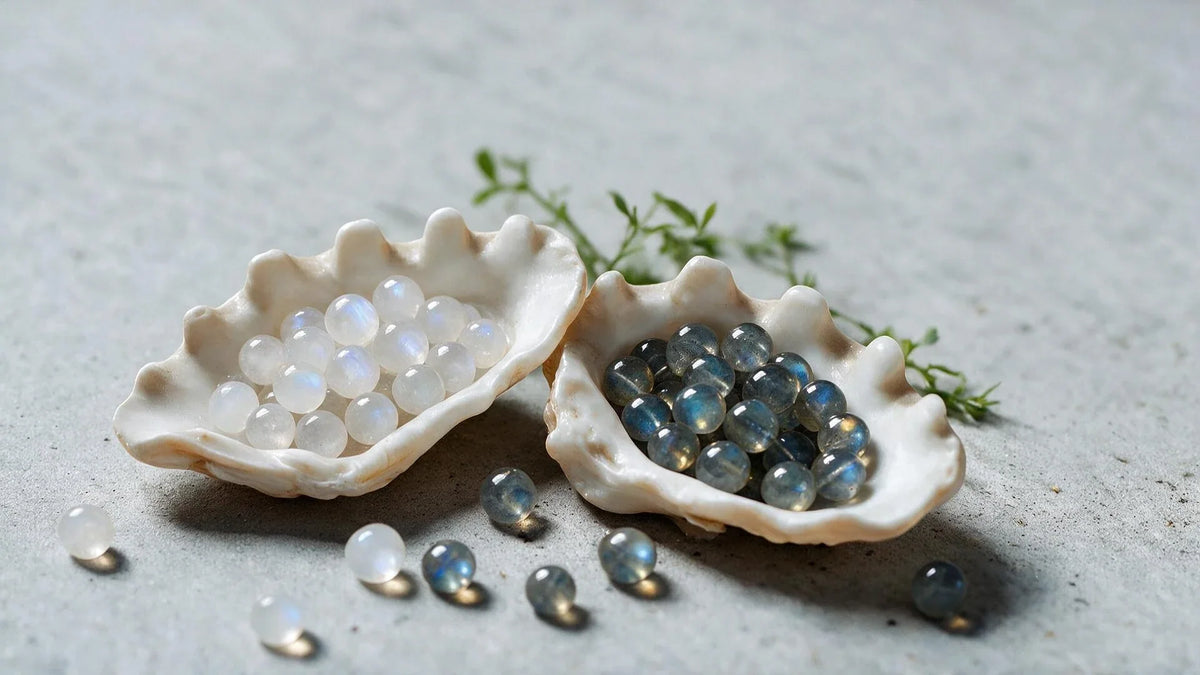
Put them side by side on a windowsill and both of them light up. Neither one is glowing. The daylight goes in, travels a short way through the stone, and comes back out as a colour that was not in the light it arrived on. Moonstone returns a soft blue-white that floats under the surface like breath on glass. Labradorite returns blue and green, sometimes with a thread of gold, and it moves as you turn it.
Same light going in. Two different things coming back. That is the whole of this comparison, and it explains why the stones keep being sold under one name: both are feldspar, both are cut as domes, and both are usually photographed the same way.
Adularescence and labradorescence: how the light works
The optical properties of moonstone and labradorite begin with the same fact: neither contains a blue pigment. What each contains is a stack of layers about a hundred nanometres thick, which is the same order of magnitude as the wavelength of visible light. Light entering the stone reflects off one layer and then off the next. The two reflections overlap, and depending on the spacing some wavelengths cancel while others reinforce. What survives comes back as colour.
That is the whole mechanism, and it is identical in both stones. What differs is how the stack was built.
Moonstone is orthoclase and albite, two feldspar minerals that mix when hot and separate into alternating sheets as they cool. The sheets are thin and highly regular, which is why the sheen is even, and why it floats rather than flashes — the effect the trade calls adularescence.
Labradorite is one mineral with two compositions. Calcium-rich and calcium-poor lamellae separate in a repeating pattern as the plagioclase cools, and the spacing varies more than it does in moonstone. A stack with more variation throws a wider range of colour, and a colour that shifts harder when you turn the stone — labradorescence.
Same physics, two ways of stacking, and the two ways give you fog and lightning.
The two pieces
The Lover's Moon is our moonstone bracelet, and the name points at the story we come to later. Pale and cool, with the sheen sitting low in the stone rather than on it. On the wrist it reads more like a change of temperature than a change of colour. We set it with clear quartz and rose quartz, so the blue has two things to sit against: one neutral, one warm. The strand is kept short so the pale stones stay close to the skin, where the sheen is easiest to see.
Worn, it does almost nothing in bad light. That is not a fault in the stone. Adularescence needs a light source with some direction to it, which is why moonstone looks like itself outdoors and goes quiet under a single overhead bulb. Indoors at night it reads as a pale, faintly pearlescent bead and very little else. Out in the afternoon it is a different object.
Stardust Aurora is our labradorite bracelet, and it is doing exactly what the name says. Labradorite from the right region flashes a range moonstone never reaches, blue into green and occasionally picking up gold, and the movement is quicker, more like something switching on than something drifting. The base is darker, black strawberry quartz set against grey labradorite, so the flash arrives in bursts against it.
Both stones are cut as domes rather than faceted: a facet throws light off the surface and away, while a dome lets it in among the layers, where the interference happens. A faceted stone still shows the colour, but as a flat sheet you have to find the right angle for, rather than a band that moves with your wrist.

Two stones that behave like two kinds of weather. One is fog; the other is lightning.
Both bracelets are in the moonstone and labradorite collection, with sizing and specifications. This page is for the difference between them.
Where moonstone's meaning comes from
There is a reason this family of stones got attached to the moon, and it is not only the colour.
The moon does not shine either. It reflects, and what it reflects arrives softened by the distance. A stone that returns a borrowed light with something added to it was always going to end up in the same category as the thing in the sky doing the same trick. That is the whole of the association, and it is older than any book about gemstones.
What is more interesting is that the two meanings people pin on moonstone, love and childbirth, do not come from the same goddess. They come from two different ones.
The love story belongs to Selene. In Apollonius she says it herself: it is not only she who has been stricken, and she has come down more than once, remembering her love, because of a song. The man was Endymion, and the version that lasted is the strangest love story in Greek myth. He was a shepherd, or a king, depending on which account you take. Zeus put him to sleep permanently, ageless and never waking, and Selene came down to look at him every night. Not once. Every night.
That is where the stone's reputation for devotion comes from, and it is a strange kind of devotion. The beloved is asleep. He cannot answer, cannot leave, cannot change. What she has is a face she can look at, and she keeps coming back to it.
Childbirth belongs to Artemis, a different moon goddess. In Callimachus she says she will only come down into the cities of men when women in labour call on her, and mythology gives her the job because she was born first and immediately helped her mother deliver her twin. She is also the goddess who asked never to marry, and who punished anyone who came too close.
So both claims are old, and they belong to two different figures. The stone people call a lover's stone is named for one goddess; the stone people call a fertility stone is named for another, and that one never had a lover at all.
There is a third version from the other side of the world, and it runs the other way. In the Chinese story it is the wife who goes up: Chang'e drinks the elixir, rises to the moon, and lives there while her husband stays below. The line people quote is about her regret, and about the same night repeating forever. The blue sea, the blue sky, the heart going through it every night.
Three stories, and in all three the moon is the thing that keeps coming back.
What labradorite means, and where it came from
Labradorite has its own story, and it is not about the moon.
The stone was "discovered" by Moravian missionaries in the 1770s, on an island off the coast of Labrador. It had been known long before that. Inuit accounts call it a fire stone, and the legend most often repeated goes like this: a warrior was walking the coast when he saw the northern lights trapped in the rocks. He struck the stone with his spear, and some of the lights broke free and went back up into the sky. The ones that stayed behind are what you see flashing in the stone.

Whether the story was ever told in exactly those words, it describes the thing correctly. The colour in labradorite does look trapped: it appears and disappears with the angle, as though it were behind the surface rather than on it, and it always seems to be arriving from somewhere else.
And the two lights are not the same kind of thing. The moon is a body. It has a surface, and you can point at it. The aurora is a process, charged particles striking the upper atmosphere and making it glow, different every night and never twice the same shape.
That is also why the difference in how you meet them matters. The moon is available. It comes out on a schedule, most nights, and anyone can look without planning. The aurora is not available. People travel to cold countries, wait a week, and go home without seeing one.
That is the real distinction between the stones, more than colour or price. Moonstone is the light that keeps its appointment. Labradorite is the light you happened to catch.
Questions
Are moonstone and labradorite the same stone?
No. Both are feldspar and both show interference colour, but moonstone is orthoclase with albite layers, and labradorite is plagioclase with calcium-rich and calcium-poor lamellae. Different minerals, different stacking.
Is rainbow moonstone actually moonstone?
Usually not. Most of what is sold as rainbow moonstone is labradorite, and the trade generally knows it. GIA describes it plainly as transparent labradorite that has been accepted under the moonstone name.
Do moonstone and labradorite fade?
No. The colour is structural, not a pigment and not a colour centre, so light does not break it down. Neither stone needs to be kept away from a window.
How hard is moonstone, and how hard is labradorite?
Both sit at 6 to 6.5 on the Mohs scale, softer than quartz and harder than the softer stones such as malachite. This matters more than it does on a harder stone: the colour depends on a polished dome, and a scratched dome scatters light at the surface instead of letting it into the layers, so the effect weakens before the stone wears out. Store them away from harder pieces. For daily wear and cleaning routines, see our crystal bracelet care guide.
Can moonstone and labradorite get wet?
Yes. Neither mineral dissolves or fades in water, and a rinse will not touch the sheen. Take them off for a swim or a long shower anyway, because the cord is the part that suffers, not the stone, and soap leaves a film that dulls the surface until you wipe it off. Pat them dry rather than leaving them wet.
Does labradorite lose its flash over time?
No, for the same reason. The flash is in the structure, not in a coating. Keep the surface polished and it keeps working.
What do moonstone and labradorite mean?
The same one as in the physics. Moonstone is the light that keeps its appointment, so the stories attached to it are about return and duration: a goddess who comes down every night, a wife watching from the moon. Labradorite is the light that arrives without warning, so its stories are about being caught out: a warrior on a coast, northern lights in the rock. Neither is a claim about the stone. Both are descriptions of what people did with it.
Which should I choose, moonstone or labradorite?
Moonstone for the quieter of the two, with the sheen sitting flat and low. Labradorite for the flash that moves and surprises. And if you cannot decide, that is roughly the distinction the two names have always pointed at: one is the light that keeps its appointment, the other is the light you happened to catch. The calendar offers a second answer. Moonstone is June's traditional stone, and the June piece is built around it: June birth month crystal. Labradorite belongs to December: December birth month crystal. The Lover's Moon takes any month as an added bead: personalized.
Ember Quiet. The ember is what the earth leaves. The quiet is what you do with it.