
Selenite — the stone people mistake for plastic
Ember Quiet Mineral Series · Selenite
You will look for a sticker
Pick one up and the first thing you do is turn it over and look for a sticker.
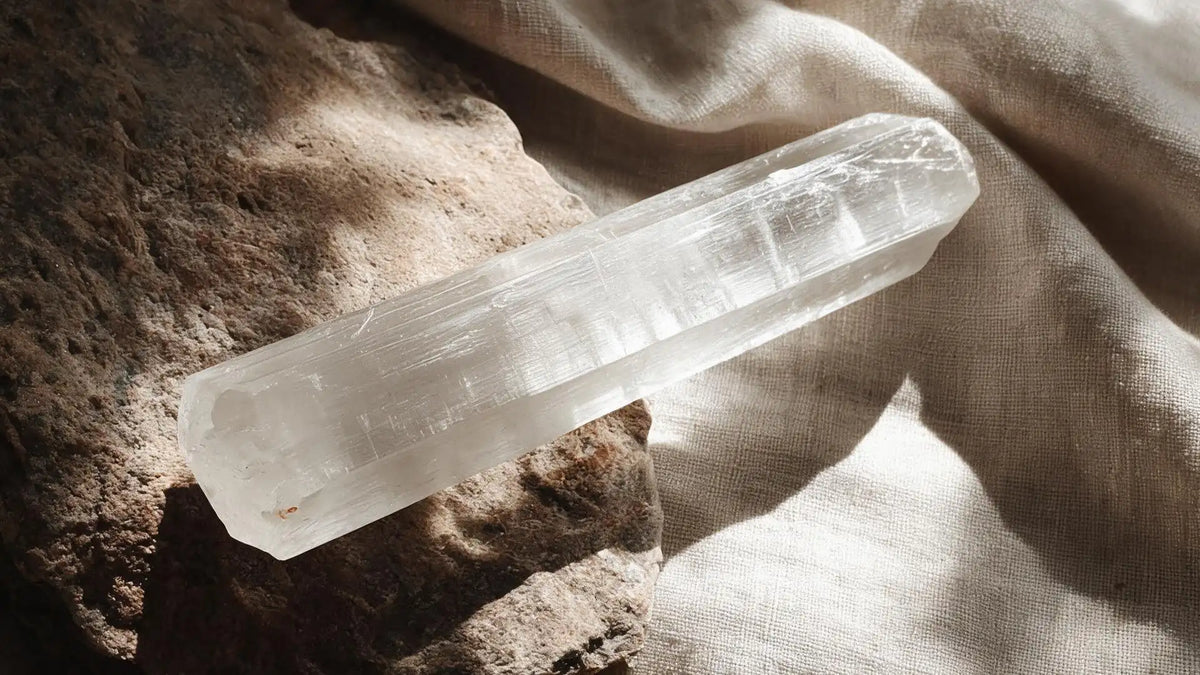
Nothing that looks like this comes out of the ground. It is too white, too even, too faintly translucent. The surface is silky rather than polished, and it is light enough that the first impression is hollow. People who handle stones for a living still ask the question, and they ask it in the same words: is this plastic?
It is not plastic. It is gypsum, calcium sulphate dihydrate, and at 2 on the Mohs scale it is the softest thing we work with. A fingernail will mark it. Water will do worse, which is a subject for later.
But the question is fair, and it is worth staying with, because the reason it looks manufactured is the same reason people have been cutting it into windows for two thousand years.
Selenite, and not another white stone
Ask anyone who works with crystals what selenite is for and you will get a short list, delivered with confidence.
It clears. It cleanses. It does not need cleaning itself, because it does not hold what it takes. You set other stones on a selenite plate overnight and they come back lighter. You stand a wand on a windowsill and the room feels different. You keep a tower in a bedroom for the same reason people keep a nightlight.
These claims are everywhere now, and they are not old, which is a distinction worth making properly later. What matters at this point is that they share one word.
Through.
Everything attributed to this stone describes something passing through it. Clearing is passing through. Cleansing is passing through. Charging another stone, which is the most common use of all, is passing through. Even the way people describe how it looks, glassy and watery and lit from inside, is a description of light that went in and came back out.

So the interesting question is not whether the claims are true. It is why this stone, and not another one. There are dozens of white translucent stones. Agate can be sliced thin. Quartz is clearer than this. Why does gypsum have the reputation for letting things pass?
The answer is in the structure, and there is nothing mystical in it.
Why light gets through selenite
Selenite properties begin with its structure. Gypsum, hydrous calcium sulphate, hardness 2 on the Mohs scale, specific gravity around 2.3, and one direction of perfect cleavage: everything this stone does follows from those four facts.
The form in jewellery is satin spar, and its crystals grow as long parallel fibres packed side by side. The stone breaks between them rather than across them, so a broken face looks silky and directional instead of granular.
The clear crystal form is the other one, and it behaves differently: it parts along a single plane into thin sheets. That is the version that went into windows.
The fibre structure does something to light. Entering the stone, light is scattered at the boundaries between fibres and travels inside the material instead of bouncing off the surface. A polished piece therefore looks lit from within rather than merely shiny, and a thin sheet passes a soft, even glow that is not clear like glass but is bright, and warmer.
This is why it worked as a window. Not because it was transparent, but because it was translucent in the right way: it let daylight through while taking the hardness out of it.
Two more properties belong here, because they explain the handling. Hardness is 2, softer than a fingernail and softer than anything else in our range. Specific gravity is about 2.3, well under the 2.65 of quartz, which is why a bead feels lighter than its size suggests. Both come from the same cause as the translucency: the structure is open, layered and loosely bound.
An open structure lets light through. It also lets other things through, and that is where the practical trouble starts.
Two thousand years of one action
The Romans cut this stone into window panes.
They called it lapis specularis, and both Pliny the Elder and the agricultural writer Columella describe it in the first century AD. Not as a curiosity. As a building material, sold by weight and by the quality of the sheet. Thin plates were set into frames to close off rooms, and glazed frames were laid over the beds of kitchen gardens so the plants would get light without getting cold. That second use is the one Columella writes about at length, and it tells you something about the material: it was ordinary enough, and clear enough, to put over vegetables.
A whole industry grew around the mining. The district near Segóbriga in central Spain has been studied as one of the most extensive of its kind in the Roman world, with shafts, galleries and a distribution network that reached Rome.
Five centuries later the same material is in a church. When the Basilica of Santa Sabina in Rome was restored in the early twentieth century, Antonio Muñoz found window elements made of gypsum plaster with translucent selenite set into them. Used as glass. For light transmission. In a building from around the year 430 that is still standing.
Then Germany, from the fifteenth century: transparent selenite used as a decorative building material, split into thin plates and set into panels. Alabaster for carving; selenite for letting light through.
Four periods. Two thousand years. One action. Somebody cut this stone thin and put it where the light needed to come in.
That is where selenite meaning comes from. Clearing, cleansing, letting energy pass. The vocabulary is modern and the reasoning is not, but the observation underneath it is the one the Romans made: things go through this stone. They were talking about daylight. The rest is a translation.
Liquid Light
Liquid Light is the selenite bracelet that came out of all of this, and the name was not chosen for atmosphere.
It is satin spar, the fibrous form, cut into beads instead of panes. On the wrist it does what a window did: it takes the light that reaches it and gives back something softer than what arrived. Indoors it stays pale and quiet. In low sun it turns warm and slightly luminous, which is the moment people photograph it, and the reason a photograph never quite matches the thing.

It is a full strand of the stone and nothing else. No second mineral is set beside it, and that is not a stylistic decision. At hardness 2, anything harder in the same piece would mark it in the ordinary course of wearing it, so the kind of composition we build everywhere else is closed off here. One material, on its own, is the only version that survives.
It also closes off the way most bracelets are worn. This is not a piece for a working week, or for the wrist that does the typing and the carrying and the washing up. It is a piece for the quiet end of a day, for the hours when nothing much is being asked of you, which is also when people tend to notice it.
One warning about the look, because it matters for how you read photographs. The whiteness is not a coating and the sheen is not a finish. Both are the structure, so they do not wear off. But they also cannot be restored: a scratched bead scatters light at the surface instead of letting it in, and it goes flat. Keep it away from keys and from harder bracelets, and the surface will hold.
It has to be remembered
This is the section worth reading before you buy, and it is short.
Gypsum dissolves in water. Not dramatically. The figure is about 2.4 grams per litre at room temperature, which sounds like nothing until you leave a piece under a running tap overnight and come back to find the edges rounded and the surface etched. Thin pieces can lose their shape entirely. Collectors have done this and written about it so that others would not.
The practical rule is not "never touch water". Brief contact is fine: a splash, a rinse of a few seconds, drying straight away with a soft cloth. What it cannot take is soaking. A bath, a swim, a sink full of water, a bathroom shelf that stays humid for months.
And there is one more thing about this stone that is genuinely counter-intuitive. Most salts dissolve more readily as water warms. Gypsum does not: its solubility rises to a peak near 40°C and falls after it, a behaviour called retrograde solubility. Hot water is not a safer option than cold.
So this is the only piece we make that asks to be remembered. Take it off before you wash your hands. Keep it out of the shower. Do not stack it against quartz. None of it is difficult, but all of it is deliberate, and that is the point.
It is a stone that makes you pay attention to it. Paying attention is most of what people mean when they say a piece of jewellery is calming. Not because the stone does anything to you. Because you have to slow down for it.
Questions about selenite
Is selenite the same as satin spar?
Mineralogically both are gypsum, but the names describe different habits. Selenite properly refers to transparent crystals; satin spar is the fibrous, translucent form. Most jewellery sold as selenite, including ours, is satin spar, and the trade has used the two names interchangeably for so long that correcting it in a product listing would confuse more people than it helped.
What is the meaning of selenite?
Less than the word suggests, and older than the word. What people attach to selenite is the idea of things passing through, which is a reading of a physical fact: light does go through gypsum, and Roman builders used it for that. Clearing and cleansing are modern words for the same observation. We would not claim the stone does anything to you. It is the one stone whose reputation came from something you can watch happen.
People ask about selenite healing properties. What is actually going on?
Something smaller than the phrase suggests, and real. Light entering this stone is scattered along the fibres and comes back out moving, which puts it in a category of visual stimulus that holds the eye without asking anything of it. That is not healing in the medical sense. It is a thing to look at that does not cost you anything to look at. If the word helps you describe why you keep it on the desk, keep using it. We would rather tell you what it is than what it will do.
Does selenite dissolve in water?
Yes, slowly. About 2.4 grams per litre at room temperature, faster in running water than in still water. Brief contact is fine if you dry it afterwards; soaking is what damages it. Consult our crystal bracelet care guide for handling soft and water-sensitive minerals.
Can I wear selenite every day?
It will survive it, but it is not built for it. At hardness 2 it marks easily and it should not meet water, so a daily piece takes more attention than most people want to give. We would call it a piece for certain hours rather than for a whole week.
Why is it called selenite, and is it the same as moonstone?
Both questions have the same answer. The name comes from the Greek selene, moon, for the pale bluish-white of clean crystals, and Pliny used it for what was probably adularia, which is moonstone. The word moved across materials over the centuries and the mineral did not, which is why an older book may describe something else entirely under that name.
How hard is selenite?
2 on the Mohs scale. A fingernail will scratch it, which makes it the softest stone we carry and the only one where a coin in your pocket is a real consideration.
Should I wear selenite with other bracelets?
No. Anything harder will mark it, and at hardness 2 that includes almost everything. It is the one piece in our range that should be worn alone.
Should I wear selenite with other bracelets?
No. Anything harder will mark it, and at hardness 2 that includes almost everything. It is the one piece in our range that should be worn alone.
Is selenite a birthstone?
Not by the standard list, but it is part of April's family here, after clear quartz: April birth month crystal. The standard stone for April is diamond, which is the one material on that list we do not work in.
Ember Quiet. The ember is what the earth leaves. The quiet is what you do with it.