
October — The Month of Compassion: Libra & Scorpio
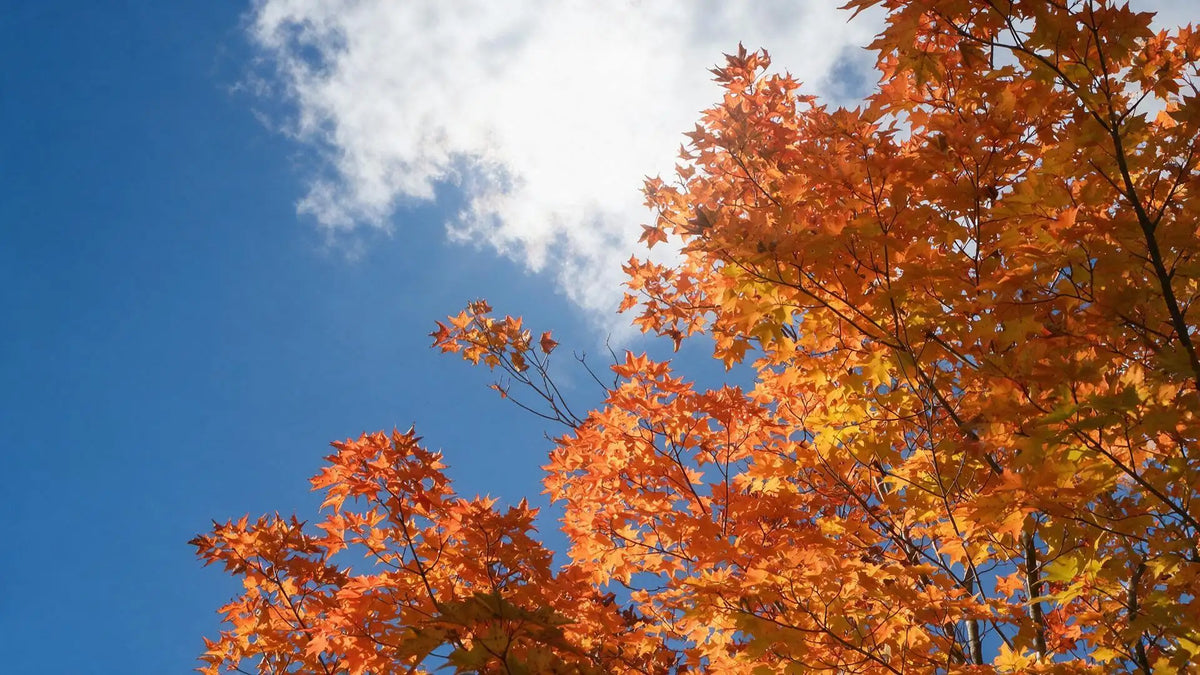
October is the month the colour underneath arrives. The orange in an autumn leaf isn't something the tree makes in September — those pigments were in the leaf the whole summer. They were simply covered. As the days shorten the tree stops maintaining its chlorophyll, the green breaks down, and what was underneath it the entire time is suddenly what you're looking at.
The tree doesn't turn orange. The green stops hiding it.
It lasts about three weeks: the year's colour at its peak and then gone — leaves that were gold on the first of the month are on the ground by the twentieth, and by November the canopy is empty. October is the window where the year looks at itself before the leaves come down.
Why October is the month of compassion
October is where the year changes direction. The harvest is finished, the cold is coming in, and the work shifts from producing to gathering in. What you need in October isn't the drive that got you through the summer. It's the willingness to stop pushing.
Everything people say about October comes out of that ease. Compassion, because when the year stops asking things of you, people start looking after each other. Unconditional love, because the warmth in October doesn't come with conditions attached. And comfort, because October's colour is soft in a way the year hasn't been since May.
There's a second thing about the month: it holds the last warm light. It's the year's warmth with the light still on it — the last stretch where being outside is a pleasure rather than an effort. By November the light has thinned out; by December it's mostly gone. October keeps both the warmth and the colour, and hands them to you without asking what you're going to do with them.
October's own words are turned toward comfort: the year is no longer asking for output.
Born in October
October holds the second half of the year's balance sign and the start of its deepest one, and the two handle the same information in opposite ways.
The handover happens around October 22 and 23, as the last of the canopy falls and the weather turns inward. The Libra–Scorpio cusp is the line between the surface and what is under it, and the pairing reads as two instincts working together: the diplomat's eye for balance and harmony on the surface, paired with an unwillingness to pretend once something is inspected from underneath.
Libra — September 23 to October 22
Libra spends October in its second half, still weighing; still the sign that makes a judgement rather than a move, and still seeing every argument from both sides whether or not that helps.
Libra is an air sign, and it deals with what's visible: how things look from the outside, how a decision sits with everyone affected by it. October is the last month of the year where that's a comfortable way to be, because everything is still on the surface.
The cost is that a scale is only useful if someone is willing to let it tip. Libra is drawn as an instrument rather than a creature, and the whole job of an instrument is to report what is there without preferring an answer. That is a real gift in a room full of people, and it can turn into a habit of keeping arrangements upright that everybody in them already knows are not: the tone kept pleasant, the thing not raised, the balance maintained past the point where balance was the useful move. A scale that will not tip is not keeping the peace. It is only postponing the reading.
The stone for October is a note about that. Rose quartz is carried for comfort, and comfort is not the same as calm. October is the month the year stops asking anything of you, which is the first chance most people get to notice what they have been holding upright, and the stone sits under that rather than over it.

Scorpio — October 23 to November 21
Scorpio arrives in the last week of October, as the colour is going. It's the sign that doesn't work on the surface: the one that would rather know a thing than be comfortable in it, and that has very little patience for arrangements which only hold while nobody looks closely.
Where Libra weighs something, Scorpio opens it. It's a water sign, the element that goes under rather than across, and it reads the whole month differently: where Libra sees a balanced composition, Scorpio asks what's holding it up.
The handoff happens while the leaves are falling: Libra attends to the visible arrangement, Scorpio to what was holding it together.
The cost runs the other way here. A sign built to check what it is given does not have a setting for a month that is not withholding anything: the good weather is not a setup, the quiet is not a warning, and the person being kind to it is not after something. Some of what a Scorpio turns over this month will pass every test and still not be believed.
That is where the stone sits. Rose quartz is carried for unconditional love, and unconditional is the harder half of it. A Scorpio can take warmth it has earned; what October offers is the kind that arrives without being earned. The stone marks the decision to accept it, which is not a lesson and not a repair.
The stone of October — Rose Quartz
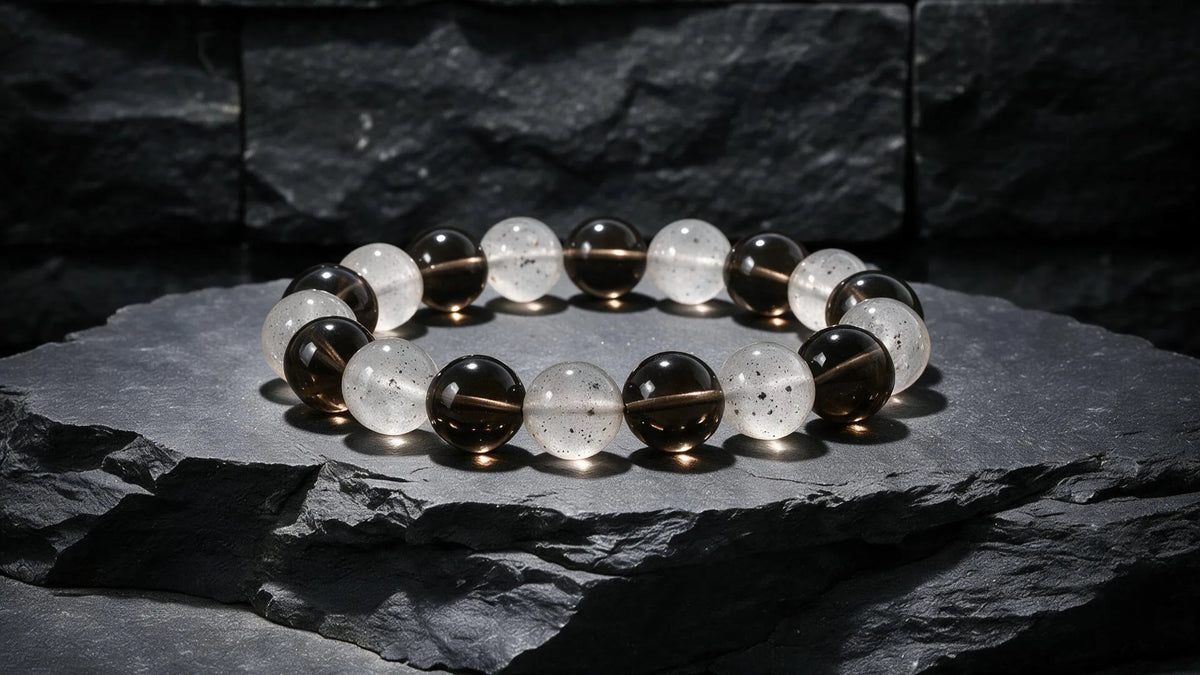
October's birth month crystal is soft rose quartz, with rhodonite, strawberry quartz, and pink rutilated quartz beside it.
Rose quartz is quartz that formed in the last hot stage of a granite body, where phosphorus, titanium and iron were present in trace amounts. The pink comes from microscopic fibrous inclusions of a dumortierite-related borosilicate mineral running through the mass; and the correction was only settled by mineralogists in the late 1990s after decades of assuming it was titanium or manganese.
The colour runs from pale shell pink to deep rose, and almost all of it is translucent rather than transparent. Because of those inclusions, rose quartz sets as masses — solid, cloudy, with no external shape to look at.
Rose quartz has a practical advantage: it holds its colour. Unlike amethyst, which fades slowly in direct ultraviolet light, rose quartz's pink comes from mineral fibres inside the quartz rather than from colour centres, making it far more stable in light than a colour-centred stone like amethyst. Not immune, but not the kind of colour a windowsill takes away.
In the best material, those dumortierite fibres run in three directions at 120 degrees to each other. When that happens the stone occasionally shows a star; cut it into a sphere and the fibres inside can line up enough to produce asterism.
Rose quartz is the stone most people think of first for unconditional love and comfort, and has been for a very long time. It's been read as a stone that softens rather than transforms: warmth without urgency, which suits a month spent easing rather than pushing.
Rose quartz has long been carried as a stone of unconditional love, comfort and compassion.
That is the same list October is about, and it is the one month in the series where the stone is the softest thing in it. Compassion here is seasonal before it is personal: the year has stopped asking anything of you, and the first thing that happens when the asking stops is that people start looking after each other. Unconditional love and comfort are what that warmth is made of.
None of that is a claim about what a stone does. Nothing here has been shown to change anything for the person wearing it. What it is worn for is the reminder, not the result.
What the stones are filed under is the month, not the sign, which is why October hands the same pink stone to a diplomat and to a sign that would rather know the truth.

Wearing it: rose quartz is quartz, 7 on the Mohs scale, and it takes everyday wear without complaint. It's one of the easiest stones in this set to live with: water is fine, a normal week is fine, and there's nothing you have to think about light with, unlike the amethyst and kunzite in February. Keep it away from harsh cleaners, but an everyday wipe is all it needs.
The other stones of October
Rhodonite is a manganese inosilicate, and its colour comes directly from the manganese rather than from an inclusion; the colour is part of the crystal structure itself. Where rose quartz is a translucent wash of pink, rhodonite is opaque and solid: a rose-red stone that often carries dark veins or dendritic patches of black manganese oxide running through it.
It's a heavier-looking stone with a deep colour built in, and it's been read as a stone of emotional recovery and grounded compassion — warmth that has some weight behind it rather than just lightness.
Wearing it: 5.5 to 6.5 on the Mohs scale, noticeably softer than rose quartz. It has perfect cleavage in two directions, which means a hard blow can split it along a plane. Wear it on a wrist, but keep it cushioned from harder stones in storage.
Strawberry Quartz is clear quartz with red or reddish-brown flecks suspended inside it. Those flecks are hematite, the same iron oxide that gives red jasper its colour and makes hematite heavy, scattered through clear quartz like seeds in a fruit. It grew popular quickly — which matters, because strawberry quartz is a trade name rather than a mineralogical one: the trade uses it for quartz with lepidocrocite, hematite, or goethite inclusions, and the quality ranges from sparse, dull specks to vivid red flakes that catch the light as you move your hand.
It carries the warmth of rose quartz with a little more direction: it's been read for vitality, enthusiasm and generosity of spirit — a lighter, brighter stone that doesn't take itself quite as seriously as rhodonite.
Wearing it: quartz, 7 on the Mohs scale, and tough. Like rose quartz it needs very little special handling; the inclusions are sealed inside the stone, so nothing on the surface can be wiped off.
Pink Rutilated Quartz is clear quartz with fine, needle-like crystals of rutile (titanium dioxide) running through it, tinted pink or copper-rose by trace iron. Where strawberry quartz has flakes, rutilated quartz has lines: thin, metallic threads that look like silk suspended in water. Because rutile has an extremely high refractive index, the needles catch the light sharply even when the stone itself is in partial shadow.
It's the most architectural of October's stones: the needles create structure inside the clear quartz, and the stone has an internal grain: light behaves differently depending on which way the needles run. It's been associated with purpose, clear intention and heart-led action.
Wearing it: quartz, 7 on the Mohs scale. The rutile needles are entirely enclosed within the quartz, so they are protected from wear, water, and cleaners. Standard gentle care applies.
Common questions
Is rose quartz the traditional October birthstone?
No. The traditional stones for October are opal and pink tourmaline. Rose quartz is the stone this collection gives October, keeping the pink palette of tourmaline while using a mineral that's quieter, harder-wearing and easier to live with daily.
Why does October have four stones?
Because they explore different aspects of the same colour. Rose quartz is the translucent wash, rhodonite is the opaque rose-red with black veins, strawberry quartz brings red flecks, and pink rutilated quartz adds metallic needles. They are all pink for different reasons: manganese, iron oxide, rutile inclusions, borosilicate fibres. The chemistry is different in each one.
Does rose quartz fade in sunlight?
No, not in normal use. Amethyst fades because its colour comes from colour centres that break down under ultraviolet light. Rose quartz's colour comes from microscopic mineral fibres embedded in the quartz, which are chemically stable. Treat it as more stable in light, not as immune to it, but a sunny room won't bleach it.
Can I wear October's stones if I was born in another month?
Yes. The months group the stones; they don't reserve them. October's stones are for anyone who wants a stone that feels like a quiet room at the end of a long year.
What is the care routine for October's stones?
Rose quartz, strawberry quartz and pink rutilated quartz are all 7 on the Mohs scale and need only everyday gentle handling. Rhodonite is the one to watch: at 5.5 to 6.5 and with good cleavage, keep it cushioned from harder stones and avoid harsh knocks. Guidelines on water, cleaning, sunlight and daily storage are in our crystal bracelet care guide.
Where to go next
October is the year's colour at its peak before it's gone. September is the clear month that let you see it coming; November is the one where the structure shows.
The twelve-month arc is gathered in The Ember Year, where each season finds its stone.
Rose quartz is worn in The Pure Heart with clear quartz, and in Wild Rose & Thorns with rhodonite. Strawberry quartz appears in The Radical Grace alongside morganite. Selected designs in the shop can also carry October's stones as a custom birth month crystal, gathered under Personalized.
Rose quartz has a collection of its own, and a longer piece on why it matters: the rose quartz collection, and rose quartz, love at the strength you can hold.