
Grounding Stones: What They Are, and Why Weight Matters
The pieces described here are in Grounding →
Why "grounding" is a word about the body first
Standing on a beach, you widen your stance without deciding to. Standing on ice, you do the opposite. Grounded began as a description of how a body meets the ground, and it moved into the way people talk about stones without ever losing the physical meaning. A grounding stone isn't one that does something to you. It's one that's already doing something you can feel: it has weight, it sits low, and it doesn't move around.
That's the honest version, and it's the one that holds up. Everything below is about weight, temperature and darkness — things you can check with your own hand.
What makes a stone read as grounding
Four things show up again and again, and every one of them is physical.
Weight. A strip of hematite beads weighs about twice what a quartz strand of the same length does, and your wrist knows it before you've decided anything about it.
Temperature. Dark, dense stones take longer to warm up. Obsidian is volcanic glass, formed when lava cooled too quickly to crystallise, and it stays cool against skin in a way that reads as solid rather than cold.
Darkness. Obsidian, hematite, smoky quartz and black strawberry quartz are the whole palette. This is the least colourful group in any crystal shop. A stone that doesn't throw light back reads as still.
Direction. Tiger's eye is the exception that proves the rule. It's the one bright stone in the set, and what makes it read as controlled rather than scattered is that its light travels in a single band instead of flashing in every direction at once.
Which stones actually carry that name
It's a working term rather than a scientific one, and nothing about it is regulated. Grounding crystals and grounding stones get used to mean the same short list: hematite, obsidian, smoky quartz, black tourmaline, tiger's eye, and the darker agates. Here's what those actually are.
- Hematite — iron oxide, 5.5 to 6.5 on the Mohs scale. It leaves a rust-red streak on unglazed tile, which is still the fastest way to identify a piece in the field. Long carried as a stone of focus and resolve.
- Obsidian — volcanic glass, 5 to 5.5. Comes in black, gold sheen and silver sheen; the sheen varieties catch light in a way plain black doesn't.
- Smoky quartz — quartz, 7 on the scale, coloured by natural irradiation while it sat in the ground. The most ordinary stone on this list, in the best sense of the word.
- Black strawberry quartz — clear quartz carrying dark mineral inclusions, visible as small suspended forms inside the stone. Close to smoky quartz in feel, different in how it forms.
- Tiger's eye — a metamorphic rock rather than a mineral: quartz that formed around fibres of amphibole which later altered in place. The gold band moves as you turn the stone. Red tiger's eye is the same material after heat treatment.
- Black tourmaline — a boron silicate, 7 to 7.5 on the scale. It forms in long striated columns, and a black one is opaque from any angle. Long carried as a stone of protection rather than of weight.
Two things travel together under this label, and they're worth separating. Grounding is about staying in place. Protection, which usually arrives in the same conversation, is about what you don't take on in the first place. Hematite and tiger's eye lean toward the first, and black tourmaline sits firmly in the second. Obsidian is where the two meet, which is why it's the stone most often carried for a boundary. That distinction is the reason the pieces below are arranged the way they are: two of them are built around protecting a boundary rather than holding a line.
One piece here carries a stone from outside that list. Lapis lazuli isn't a grounding stone: it's carried for the throat, for truth and for saying a thing out loud. In True North it works as the other half of a hematite pairing, where the hematite holds the weight and the lapis holds the voice.
None of that is a claim about what a stone does. Nothing here has been shown to make anyone steadier, and what these pieces are worn for is the reminder, not the result.

Three things people get wrong about grounding stones
That heavier means stronger. Weight is a physical fact about iron oxide and volcanic glass. It isn't a measure of anything else, and the heaviest stone here is not the hardest one. Hematite is 5.5 to 6.5 and obsidian is 5 to 5.5, both softer than the quartz they're usually paired with.
That they're interchangeable. Hematite is metallic and cold; obsidian is glass and reads matte; smoky quartz is translucent. Put them side by side and they don't look like the same category of object. The one you choose changes what the piece feels like far more than it changes anything else.
That any of them make a situation better. Not in the way that sentence means — the noise stays. What people describe is smaller: a weight on the wrist that is the same at nine in the morning and at nine at night, and something fixed to come back to when the day moves. If that counts as better, take the word; we are not going to argue about it.
Wearing one, day to day
This is the least demanding group of stones we work with. Nothing here requires a ritual, a schedule, or a particular wrist — and if you keep one anyway, that part is yours. What it needs is to be on you at the moments that are hard to hold: a commute, a long meeting, a room with too many people in it.
Two practical notes before you choose. Heavier stones move more, so a hematite strand will slide on a wrist that's smaller than it looks; check the size first. And dark stones hide scratches better than clear ones but show dust and skin oils faster. A wipe with a soft cloth brings the surface back.
Storage matters more here than in most groups, for a reason that isn't obvious: obsidian and hematite are both softer than the quartz beads sitting beside them in the same box. Given enough time loose in a drawer together, the harder stone wins. A pouch per piece is the whole fix.
Why these pieces are one group
Every crystal shop sells grounding stones. Almost none of them explain how the pieces differ from each other, which is the only question that matters once you've decided you want one.
So the collection is split three ways, and the split is by situation rather than by stone. Grounding is the group for holding your position. Love & Forgiveness is the group for what the heart does. Healing & Clarity is the group for what happens inside your own head.
Inside this one, the pieces sit on two lines. One line runs from dark to bright: The Silent Orbit at the darkest end, The Triple Vision at the other, and the rest between them. The other line sorts them by material: two obsidian pieces and two hematite pieces. The Earth Anchor and The Mirrored Veil are the obsidian pair. The Iron Hawk and True North are the hematite pair.
That's the map. Here they are in one place, darkest to brightest:
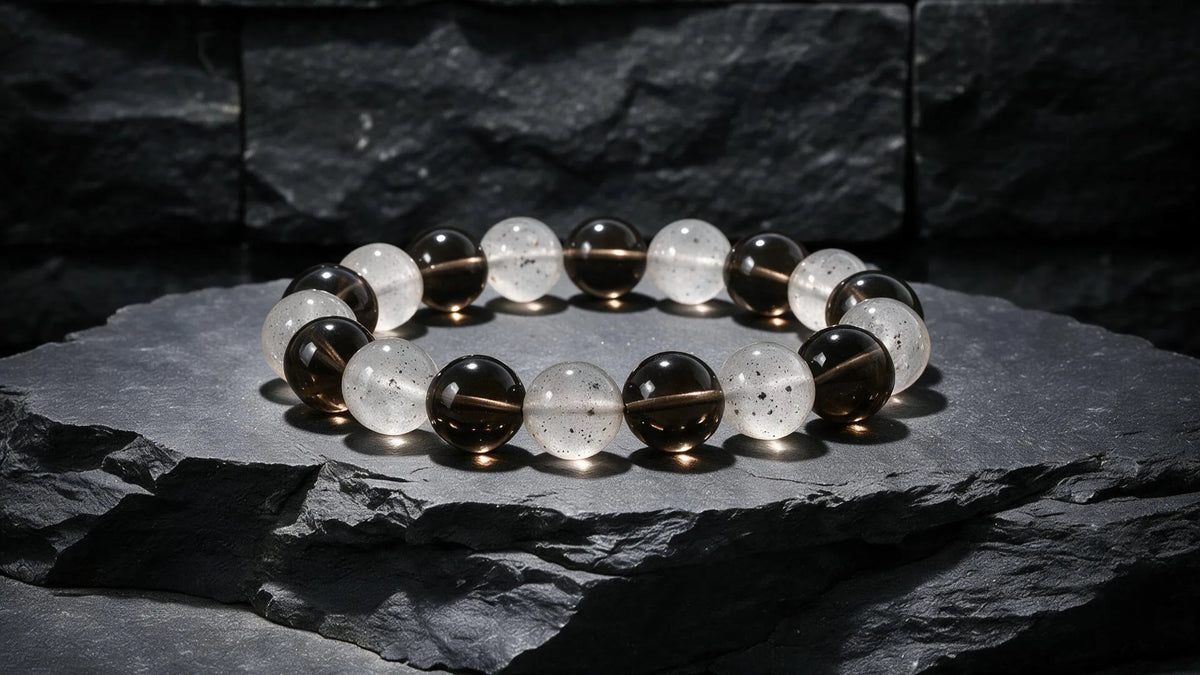
- The Silent Orbit — smoky quartz and black strawberry quartz, and nothing else
- The Earth Anchor — obsidian, built to hold a direction
- The Mirrored Veil — obsidian, built to keep a room from following you home
- The Iron Hawk — hawk's eye over hematite, for reading a situation
- True North — lapis over hematite, for saying the true thing once you have it
- The Triple Vision — tiger's eye in all three colours, the one with light in it
What follows is each piece, one at a time.
The Iron Hawk · Third Eye & Root Bracelet
The name. A hawk sees the whole field at once and doesn't move until it's worth moving. The \"iron\" is literal — the weight is half the design.
The stones. Blue hawk's eye is tiger's eye before the fibres have altered all the way, so instead of a gold band it holds a blue-grey one that shifts like a horizon. Hematite, dense and metallic, sits between the blue beads. The two halves of the piece are a stone that reads a situation and a stone that keeps you planted while you read it.
Where it sits. This is one of the two hematite pieces, and the difference between them is what the weight is holding. Here it holds a read. Hawk's eye is the most directional stone in the group, and the piece is built around that. True North puts the same hematite under a blue stone, and there the weight holds a voice rather than a view. Sight, or speech.
When. Meetings, negotiations, travel, and any room where the useful move is to say less and notice more.
True North · Throat & Root Chakra Bracelet
The name. A compass needle doesn't argue, and it doesn't need anyone to agree with it. The piece is named for the version of yourself that already knows what it thinks.
The stones. Lapis lazuli isn't a mineral but a rock, lazurite with calcite and pyrite in it, which is why no two beads carry the same blue. The pyrite is the gold speckling, natural to the stone rather than applied. Hematite sits between the blue beads and does the opposite job: lapis is 5 to 6 on the scale and softer than it looks, while hematite is dense and hard-wearing and is the only reason the strand hangs the way it does.
Where it sits. The other hematite piece here is The Iron Hawk, and both use weight as a reminder. What separates them is what the reminder is for. One is for seeing a situation clearly; this one is for saying the true thing once you already have.
When. Interviews, presentations, conversations you've been rehearsing, and decisions you've been circling.
The Earth Anchor · Root & Solar Chakra Bracelet
The name. An anchor is a weight you drop on purpose, and the earth under a storm doesn't move. The two halves of the name are the same fact seen from above and from below.
The stones. Both stones are obsidian, and the pairing is about darkness with a light inside it rather than darkness alone. Black obsidian is matte and heavy; gold sheen obsidian is the same material with a different internal structure, and it holds a warm flare that only appears when the stone turns. The first stone holds you still; the second is what stops still from becoming flat.
Where it sits. The obsidian pair in this group is this piece and The Mirrored Veil, and they're doing different jobs. This one is built to hold a direction, and it reads heavier for it. The Mirrored Veil is built to let a room pass without landing on you. Direction, or boundary.
When. Commutes, business travel, long workdays, rooms with more people in them than you'd have chosen.
The Mirrored Veil · Root & Third Eye Bracelet
The name. A veil is what you put between yourself and a room; a mirror is what makes the room slide off instead of settle on you. The piece is named for the two halves of the same move: silver sheen obsidian has an almost mirror surface that catches light without ever becoming bright, and the veil is what that surface is doing.
The stones. Silver sheen obsidian is the reflective half: volcanic glass, dense and dark, with a sheen that only shows at an angle. Smoky quartz is there to stop the piece reading cold. Obsidian on its own would read as a wall; with the quartz beside it, it reads as something you can stand behind.
Where it sits. The other obsidian piece here is The Earth Anchor. That one is built to hold a direction; this one is built to keep a room from following you home. If you know which of those two sentences describes your week, the choice is made.
When. Crowded rooms, difficult conversations, travel days: anywhere the point is to leave with the same mood you arrived in.
The Silent Orbit · Root Chakra Bracelet
The name. An orbit is a path something holds while everything inside it is falling. The piece is named for a stone that looks like it has its own small system and isn't asking to be part of yours.
The stones. Smoky quartz is the quiet half. Beside it is black strawberry quartz: clear quartz with dark mineral flecks caught inside, which is what gives the strand its planetary look. Smoky quartz on its own would be a flat dark line. The flecks are what make it read as something with depth rather than something solid.
Where it sits. This is the darkest and least specific piece in the group, and that's its argument. The Triple Vision is the far end of the same line, and it's the only piece here with real light in it. If you can't decide, this is the one that commits you to the least.
When. Commutes, travel, a full week of work hours. The days that don't have one dramatic moment, just a lot of them.

The Triple Vision · Triple Tiger's Eye Bracelet
The name. Three stones, three colours, one material at three different stages. The name is about seeing the same thing from more than one distance.
The stones. All three are tiger's eye, and the fibres in each run parallel, which is why the band of light moves when you turn the stone instead of flashing in every direction. Blue hawk's eye is the raw end of the sequence, golden tiger's eye is the familiar middle, and red is the same stone after heat treatment, which is why we list it as treated rather than as natural.
Where it sits. This is the one bright piece in an otherwise dark group, and it's worth having as one. The Silent Orbit sits at the opposite end — the darkest and quietest thing here. The pieces between them are variations on holding a line, rather than on seeing or not seeing.
When. Decisions with a long tail, presentations, and anything that takes months rather than an afternoon.
How to choose between them
Start with what you want in your hand, not with what you want to happen.
If you want the heaviest pieces we make, that's The Iron Hawk or True North. Both carry hematite, and both feel like they mean it. If you want dark and quiet, The Earth Anchor and The Mirrored Veil both work in obsidian. If you want the least specific piece in the group, that's The Silent Orbit. And if you'd rather have the one bright stone, The Triple Vision uses tiger's eye in all three of its colours.
None of them will change a situation, and that was never the offer. What is on offer is smaller and easier to check: it's heavy, it's cool, and it's on your wrist. When your hand goes down on a desk, you feel it. That's the mechanism — a reminder you can feel rather than one you have to remember.
If that sounds like too little, it probably is, for some people. If it sounds like enough, that's the whole reason this group exists.
Where this fits
The collection is arranged into three groups, and this is the one about weight. Love & Forgiveness is about what the heart does; Healing & Clarity is about getting a clear view of something.
All of these pieces are gathered in Grounding, where each strand is described in full.
Common questions
What are grounding stones?
A working term rather than a scientific one, used for stones that are heavy, dark and cool (hematite, obsidian, smoky quartz, black tourmaline, tiger's eye). Nothing about the label is regulated, and it describes what these stones feel like more than anything they do.
Which one should I pick if I want the weight to be obvious?
The Iron Hawk if you want the heaviest. The Silent Orbit if you want the least specific. The Triple Vision if you'd rather have something with light in it.
Is hematite or obsidian better?
They're closer than the shops make them sound. Both are dark, both are dense, both sit cool against skin. Hematite is heavier and has a metallic sheen; obsidian is glass and reads matte beside it. If you want weight you can feel through a sleeve, hematite. If you want something that disappears into what you're already wearing, obsidian.
Can I wear more than one?
Yes, and people do. There's no rule against it. The practical limit is the one you'd guess: two heavy pieces on the same wrist is a lot of weight, and you'll notice it sooner than you'd think.
Do these chip more easily than other stones?
Yes, and it's worth knowing which end they're on. Hematite is 5.5 to 6.5 and obsidian is 5 to 5.5, both softer than the quartz they're paired with, so they take a mark before the quartz does. Wear them against skin or cloth rather than metal, and keep them off hard edges. Water, cleaning and storage are covered in our Crystal Care & Wear guide.