
Obsidian — the stone that was a blade before it was a bracelet
Ember Quiet Mineral Series · Obsidian
Pick up a strand of black obsidian and your hand gets two things wrong at once.
It expects weight, because dark stones usually run heavy. This one is lighter than the quartz on the same table. It expects cold. Obsidian reads cool for about a minute, and then it is simply your own temperature.
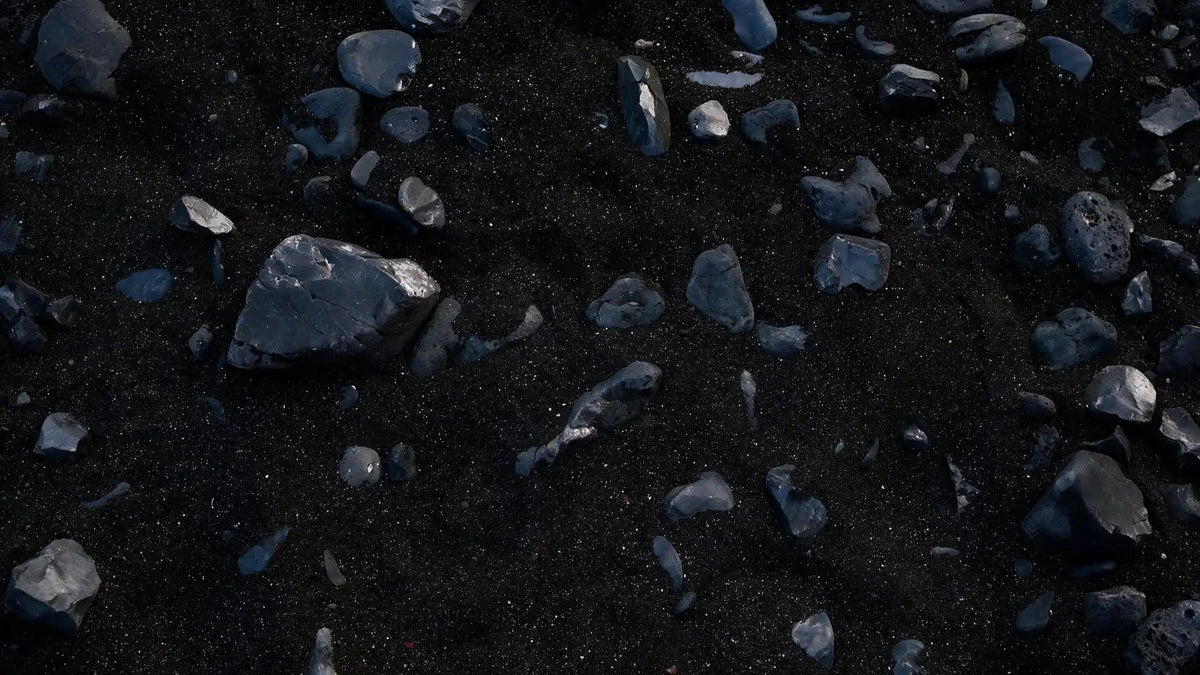
The reason is simple: obsidian is not a crystal. It is volcanic glass: lava that cooled too fast to arrange itself, froze in whatever shape it was moving through, and stopped there.
The word glass causes trouble here, so let us be exact. Nobody made this one. The first glass humans produced was around 3500 BC in Mesopotamia, and it was opaque beads. Obsidian is usually under twenty million years old. The earth was making glass long before we worked out how, and we have been copying it ever since.
What obsidian is
Obsidian runs 65 to 80 percent silica, close to granite, with one difference that decides everything else: under one percent water. Water and time are what let minerals grow. Cool the lava fast enough and there is no time to grow anything, so what you get is an amorphous solid: no grains, no cleavage, nothing inside for light to catch on. Only glass.
Obsidian properties come down to three numbers, and each one changes how you wear it. Specific gravity 2.35 to 2.6 against 2.65 for quartz, so a bead of it is lighter than the same size in quartz. Hardness 5 to 5.5 against 7, so quartz marks obsidian and obsidian does not mark quartz. And the fracture runs in curves, the way a bottle bottom breaks, because there is nothing inside to tell a crack which way to go.
Black onyx is the stone most often confused with it, and the difference is structural rather than visual. Onyx is chalcedony, a crystalline form of silica, and it is harder: 6.5 to 7 against obsidian's 5 to 5.5. It also breaks differently. Onyx fractures along a surface; obsidian shells, leaving a curved glassy face. Weight and edge settle it faster than colour does.
One more fact rarely gets mentioned. Obsidian is thermodynamically unstable. It is not a stone that has arrived; it is a process that got frozen, and over a few million years it will slowly crystallise back into ordinary rock. What you are holding is somewhere in the middle of that.
The name arrived late, like most names do. Pliny the Elder, writing around AD 75, described a black glass from Ethiopia and called it obsiana, after the man said to have brought it back. People had been using the stone for thousands of years by then.
The obsidian edge
Before obsidian was cut into a bead it was cut into an edge, and for most of human history that edge was the best one available.
Nothing inside turns a strike aside, so it passes straight through, and the piece that comes off can be a few molecules wide along its edge. Flint is sharp. Obsidian is sharper, and it takes less work to get there.
The finest of these were made in Mesoamerica about 2,500 years ago: prismatic blades, struck from a prepared core in a sequence that produced long, regular, near-identical pieces.
The regularity is the point. It is not a lucky flake. It is a standard: a blade you could make again, to the same length, on the day you needed another one.
Which tells you what the stone was for. Set into a shaft, that edge became a spear point. A spear point has two jobs, and neither of them is fighting: bringing food home, and stopping something that meant harm. That is the whole reason a person could leave the shelter and expect to come back. For the person holding it, having one and not having one was the difference between a night that ended and one that did not.
It kept people alive. Not as a metaphor; as a tool.

Where obsidian's meaning comes from
Bronze and iron replaced it for most work, and not because they cut better. They cut well enough, and unlike glass they could be straightened and re-ground after a bad day. The blade went out of use. The word did not.
The oldest descriptions of this stone are full of the language of keeping things out. That is not mysticism arriving from nowhere. That is what a blade is for, said in the vocabulary people had at the time.
That is where the meaning of protection comes from: a job a tool did in daily life, kept and then transferred to the stone.
A second layer is visual rather than historical. Most stones answer the eye. Quartz throws a little light back; a polished agate shows a band of colour; even a dull stone has a grain you can follow. Black obsidian answers nothing. Look at it in daylight and you get darkness with no depth in it, and a surface that gives nothing back is an easy thing to describe as holding something instead. Nobody had to invent that reading. It is what the surface does, said in the language available.
Put the two together and you have the reason obsidian has been carried as a protective stone in a great many places for a very long time. Not because a tradition says so, and not because anything was measured, but because it genuinely was the thing standing between a person and what was coming, and because at rest it looks like a boundary.
When a tool like that becomes an ornament, the role does not disappear. It changes what it is guarding.
Three pieces
Almost nothing we make is a single stone, and no black obsidian bracelet here is one stone either. Alone, it is a black surface. Beside something else it becomes a background, and the background decides what the other stone looks like.
Each of the three started from a word, not a material.
The Earth Anchor is an anchor. A boat stops not by pulling harder but by holding one fixed point, and this is the most fixed thing we work with: it came up from below, cooled before it could change, and its composition has barely moved since. That is where the name comes from — something out of the earth, used to hold a position.
The two blacks it pairs are not the same black. Plain obsidian returns nothing; gold sheen returns light, but only at the right angle, which means only when you move. So the piece is silent most of the time and answers occasionally, and that one answer is the reason it holds two blacks instead of one.
We made it for rooms where you would rather not be read: a meeting, a negotiation, a first day somewhere new. It does not announce anything. It will decline to be transparent.

The Astral Gate is a gate, not a panel. A gate means it is open, just narrow.
Kyanite is a bladed mineral with a strong directional lustre; it holds a line of light along one axis. Set against black glass, that line becomes the only bright thing in the strand, and the eye goes to one point instead of travelling around the wrist.
We made it for the times you only need to see one thing clearly. Not all of it. One line. We keep it narrow on purpose, because narrow is what you can walk through.
The Mirrored Veil is the same glass in its other version. Silver sheen obsidian carries a layer of aligned inclusions fine enough to throw light back, so what you see is the light and not what is behind it. Plain black is a wall; silver sheen is a veil. The difference is one layer at the surface, and you can see it by turning the bead.
The smoky quartz beside it does the opposite. It does not return light; it lets light pass through the body of the bead. One reflects at the surface, the other admits at the centre, and together they say only this: you can see me, but not through me.
We made this one for being seen without being read. A client meeting. A room of people you are still working out. A veil can be lowered. A wall cannot. That is the whole difference we were after.

Three pieces, one black, three words: an anchor holds, a gate admits, a veil turns aside. Which one you choose is a question about which of those you need this year. All three are in the black obsidian collection, where the two blacks sit next to each other. That is the only way to see the difference without ordering both.
Questions
Is obsidian real glass?
Yes. It is a natural volcanic glass, formed when silica-rich lava cools too fast for crystals to grow. It has no crystal structure and no mineral formula, which is why it is classified as a rock rather than as a mineral.
Does obsidian scratch?
It can. Obsidian is 5 to 5.5 on the Mohs scale, softer than quartz. Keep it in its own pouch rather than loose with harder stones, and the surface stays as it arrived.
Why does some obsidian shine gold or silver?
Because of layers too thin to see. Gold and silver sheen obsidian carry aligned inclusions at nanometre scale that reflect light back at particular angles. Tilt the bead and the sheen moves; that movement is the layers catching light.
Is obsidian heavy?
Less than you expect. Specific gravity is 2.35 to 2.6, slightly under quartz at 2.65. It feels solid rather than heavy, because glass has no grain for your fingers to read.
Is obsidian really a protective stone?
It has been carried as one for a very long time, in a great many places, and the reason is on this page: it was a blade before it was a bead. What that means now is narrower than the phrase suggests. A stone you keep on your wrist is a marker, not a shield.
Can you wear black obsidian every day?
Yes, with one habit: keep it away from harder stones and from knocks. The edges are thin and the fracture is conchoidal, so a chip does not come back. Worn on its own wrist, it holds its surface for years.
Can you wear black obsidian every day?
Yes, with one habit: keep it away from harder stones and from knocks. The edges are thin and the fracture is conchoidal, so a chip does not come back. Worn on its own wrist, it holds its surface for years.
Is obsidian a birthstone?
Not by the standard list, but we carry it in January's family, where garnet leads and black obsidian sits beside it: January birth month crystal. Gold sheen obsidian belongs to November, where the same stone turns up in a warmer colour: November birth month crystal.
Ember Quiet. The ember is what the earth leaves. The quiet is what you do with it.