
Malachite — the stone that is named soft
Ember Quiet Mineral Series · Malachite
The name: what malachite means
Malachite comes from the Greek malakos, which means soft.
The name is accurate. Malachite sits at 3.5 to 4 on the Mohs scale, roughly half the hardness of quartz. A fingernail will not mark it. A key will. Few stones have a name that doubles as a test result.
It is also a summary: the shortest history this stone has. Someone noticed it, someone worked it, and someone is still explaining why it looks the way it does. All three of those people are in those two syllables.
What malachite is
Malachite properties, in the plain technical sense, come down to three numbers: hardness 3.5 to 4, specific gravity 3.9 to 4.0, and one chemical formula, Cu₂CO₃(OH)₂. Everything else about it follows from those three.
Malachite is a copper carbonate hydroxide, Cu₂CO₃(OH)₂. It does not form the way primary ore forms. It is secondary, which means it is made from something else that was already there.
The sequence runs like this. A body of primary copper sulphide sits in rock. Near the surface, water and oxygen reach it and the sulphides break down. Copper dissolves into the groundwater as a sulphate, travels a short distance, and then meets carbonate in the surrounding rock. Where it meets it, the copper recombines and drops out of solution as this green. The whole process happens in what miners call the oxidised zone, the weathered cap at the top of a copper deposit.
That is why malachite is not found by digging deep. It is found where the ground has been rained on for a very long time. The conditions are the same anywhere: a long, slow, undisturbed weathering, and carbonate rock nearby to catch the copper on its way down.
One thing worth knowing about the green: it is not a stable end point. Malachite is only stable within a certain range of acidity, and outside that range the copper starts moving again. That is why the stone should never meet acid, and why everything on this page about water and perfume is chemistry rather than fussiness.
How malachite was found
It is one of the first copper ores anyone ever smelted, and the archaeological record is unusually blunt about why.
The earliest evidence of copper working in Europe comes from Belovode in Serbia, around 5,000 BC, in the Vinča culture. Excavation reports describe malachite collected from surface outcrops because the colour was visible. Early mining was shallow and open: the ore announced itself from the ground.
Three thousand years later and several thousand miles east, the same thing happened in Hubei at Tonglushan—a name that translates as Copper Green Mountain. Worked from the Shang dynasty into the Han, its principal ore was malachite. What makes Tonglushan more than a hole in the ground is that it was an industry: shafts, galleries, timbering, drainage, a workforce.
They also read plants. A local herb, elsholtzia, takes up copper through its roots and flowers purple in November, and the saying went that purple flowers meant copper underneath. They looked at the ground for green and at the vegetation for purple, and between the two signals they found the metal that made the bronze.
The scale explains the effort: across the Shang and Zhou periods, the bronze vessels alone run into the tens of thousands. That volume required mines that worked at scale.
Human beings smelted metal for the first time, and what they reached for was not the hardest stone in the river. It was the most visible one.
The colour
Before any of the explanation, the colour deserves its own sentence.
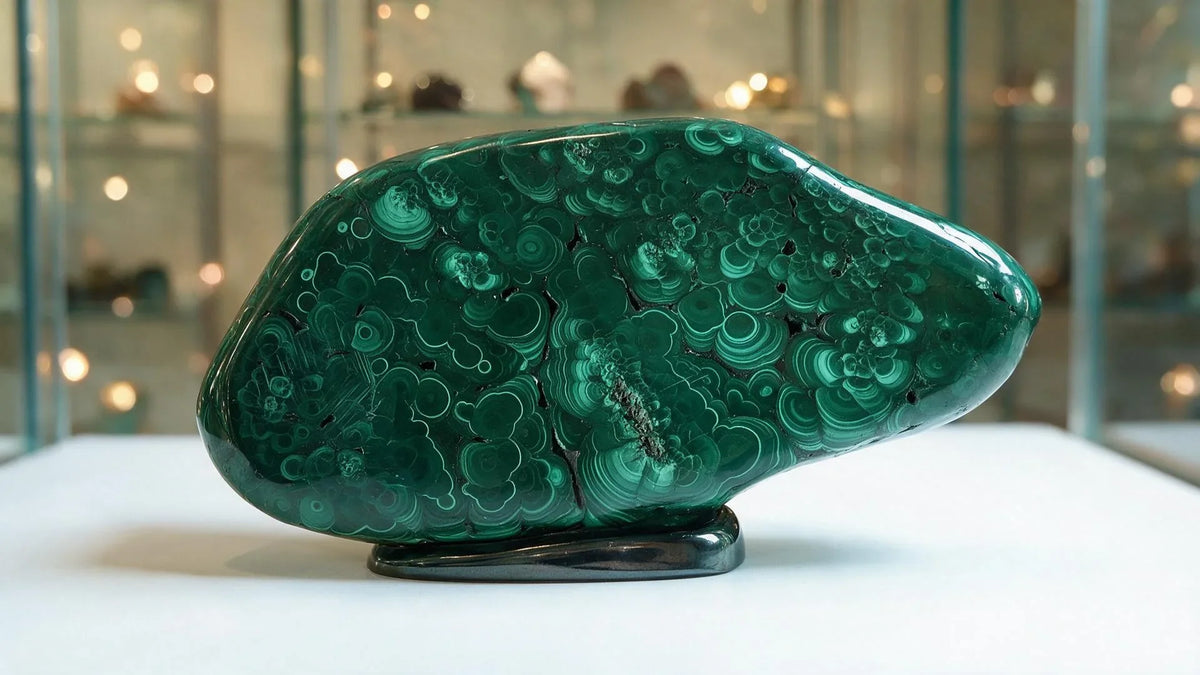
Malachite green is the most saturated green in the mineral world, and it holds its intensity in a way almost nothing else does. In one stone it can run from a thin mint at the edge of a band to a green so dark it reads almost black at the centre, and the transition happens over a few millimetres. There is no other stone on our table that carries that much colour in that little space.
It is also the reason for the first half of the name. A peacock's tail feather has the same colour and the same concentric eye, and the comparison is old enough that it named the stone in several languages.
Now the explanation, which is smaller than the colour and worth knowing anyway.
Green is the colour the visual system reads as recovery. A 2022 study in Environmental Research compared looking at images of plants against looking at a plain green field, and measured stress recovery in both conditions. Green is not a neutral stimulus. It sits in a different place in the visual system than grey does, and the difference shows up in physiology, not only in preference.
So the colour is doing something, and it is doing it before you have decided anything about the stone. What it is not doing is making a decision for you.
The pattern
The pattern is the part people photograph, and it is worth saying why before saying how.
No two pieces band the same way. Inside one stone the direction can change from one layer to the next, so that a single bead may show three different grain directions in a space the width of your thumb. The colour follows the layers rather than the shape, which is why a round bead can look striped, swirled or nearly solid depending on where it was cut.
And then there is the shape of it: malachite has no straight lines.
The banding is concentric. Arcs inside arcs, each layer laid down as the mineral grew outward from a surface, one on top of the last. Every edge in the stone is curved. There is not one right angle anywhere in it.

That shape has a measurable effect. Bar and Neta, publishing in Psychological Science in 2006 and again in Neuropsychologia in 2007, found that people consistently prefer curved objects to sharp-angled ones, and traced the effect to the amygdala, the structure that responds to threat. Sharp angles increase activity there. Curves do not. The preference is not taste. It is the absence of an alarm.
The pattern also holds the eye without spending attention. Kaplan's attention restoration theory calls this soft fascination, and gives leaves moving in wind and light on water as examples. Soft fascination occupies the visual system while leaving the mind free. Its opposite is anything that grabs and holds: a screen, a headline, an alarm. One restores, the other spends.
So the piece is doing two things at once, and neither of them is subtle in the way it works. The green lowers the baseline. The curves keep it from ever rising.
The two pieces
Choosing a malachite bracelet here means choosing the softest stone in the strand, and both of ours are built around the fact that you cannot treat it casually.
Forest Breath is a clearing, and the name is literal. A clearing is not an absence of forest; it is the part of the forest where the canopy opens and light gets through. That is the piece: malachite running through misty cloud agate, with the agate breaking the banding into intervals rather than letting it run unbroken around the wrist. The green is still the subject, but there is air in it. We made it for the moment when something needs to be put down rather than carried further, and the pattern is doing the same thing the name is: making room.
Resilient Bloom is the other side of that same moment, the stretch between what has ended and what is ready to take root. Malachite banded with red agate, which sits against the green hard rather than softly, so the piece reads warmer and a little more insistent than Forest Breath. The two stones are not blended; they alternate, and the alternation is the point. We made it for the season after something, when the ground is not empty but nothing has come up yet.

Both are in the malachite collection, where the two band rhythms sit side by side.
Both are built to be worn on their own wrist. Malachite is 3.5 to 4 on the Mohs scale and the agate beside it is 6.5 to 7, so the softest thing in the piece is the thing you are looking at. Perfume, hairspray and lotion go on before the bracelet, not after. It comes off before you shower, swim, or wash your hands with soap. These are not precautions against a rare problem. They are the ordinary conditions of the material.
We are not going to tell you it will fix anything. What it does is smaller and older than that: it is a green thing with no straight edges on your wrist, and your eyes do not have to brace against it. If that reminds you to slow down for a second, the reminder was already yours. The bracelet just happened to be there when you remembered.
Questions
What is the meaning of malachite?
When people look for malachite meaning, the name itself means soft, and the stone agrees with it. But the older meaning people are usually asking about is different: for five thousand years this was the stone you could see from the surface, the one that told you where the copper was. It meant visibility before it meant anything else.
People ask about malachite healing properties. What is actually going on?
A smaller thing than the phrase suggests, and a real one. Natural green lowers baseline visual tension, and concentric curves do not trigger the amygdala's threat response. That is not healing in the medical sense; it is a surface your eyes do not have to brace against. If the word helps you describe why you keep picking it up, keep using it. We just are not going to sell it to you as medicine.
Can malachite get wet?
Brief contact is fine. Soaking is not. Water dissolves copper carbonate over time, and acidic sweat will dull its polished luster. A barely damp cloth is all it needs for cleaning; for complete details on caring for softer stones, see our crystal bracelet care guide.
Is malachite toxic?
The dust is. Malachite contains copper, and inhaling dust from cutting or grinding it is a real hazard for the people who work the stone. A finished, polished bead is not a hazard to wear. Those are two different things, and most of what you read online runs them together.
Does malachite scratch?
Easily, yes. At 3.5 to 4 it is the softest thing in the piece, and softer than anything else in the same strand. A fingernail will not mark it; a key will, and so will a quartz bracelet stacked against it. Wear it on its own wrist.
Is malachite rare or expensive?
Not rare as a material, and not expensive at the low end. What is uncommon is size and pattern: a large, evenly banded, well-cut piece is scarce, and that is where the price goes. Much of the cheap malachite on the market is either reconstructed from stone dust and resin, or dyed.
Is malachite a mineral or a rock?
A mineral. It has a single defined chemical formula, Cu₂CO₃(OH)₂, which is the line between the two.
What is the difference between malachite and azurite?
They are neighbours: both copper carbonates, forming in the same oxidised zone, one green and one blue. Azurite carries more copper and less water, and it is unstable in air, slowly taking on water and turning into malachite. That is why blue is rarer than green in old material. A specimen with blue crystals sitting on green is the change caught partway through.
Is malachite dyed or reconstructed?
Both exist and both are common. Natural malachite has banding that changes direction from one layer to the next and never repeats exactly. Reconstructed material, ground stone set in resin, has banding that looks poured. Ours is natural, and no two beads carry the same pattern.
Is malachite a birthstone?
Not by the standard list, but it is August's second stone here, sitting beside prehnite: August birth month crystal. The standard stone for August is peridot, which is a different mineral in a similar colour.
Ember Quiet. The ember is what the earth leaves. The quiet is what you do with it.