
Amethyst — the colour of the moment after
Ember Quiet Mineral Series · Amethyst
The last light goes out of the room and you do not get up. Not yet.
The day is finished in every way that matters. The phone is face down. There is nothing left that has to be answered tonight. And still you sit there, in the gap between the ending and the sleep, doing nothing that could be written down.
That gap is what this page is about.
Why amethyst fades
Purple is scarce. Flowers and shells do produce it, but rarely, and usually as a warning or a lure.
It is also the last colour the eye can see. Violet sits between 380 and 430 nanometres; past that is ultraviolet, which we cannot see at all. So purple has no home of its own. It only exists on the way to somewhere else.
Three thresholds
Purple never stays. That is what the three things below have in common: each one is a colour that appears at the moment something changes.
The first is a story most people have heard without knowing where it began. A nymph named Amethystos was pursued by Dionysus, who was drunk and would not stop. She prayed to Artemis, who turned her into white crystal so that no one could take her. When Dionysus sobered and saw what he had done, he poured his wine over the stone, and it took the colour and kept it.
The purple in that story is not the colour of the wine. It is the colour of the moment after. After the pursuit ended. After he came back to himself.
Lavender is the quieter version of the same moment, and it comes with a strange condition. It grows best in poor ground. Give it rich soil and it produces lush leaves with almost no scent; give it thin, stony, fast-draining ground and the oil goes up, the colour deepens, and the smell carries.
Its flower language is silence and devotion. That is not an accident of Victorian card-making. It is what you get from a plant that gives more when it is given less.
It also arrives and leaves inside one summer. Cut it in the right week and it holds its scent for years in a drawer. Leave it a week too long and it goes brown on the stem.

Wisteria is the one that means welcome, and it means it slowly. Grown from seed, a wisteria can take seven to fifteen years before it produces a single flower. Most do not bloom in any real abundance until their seventh or eighth year. People plant them over a door anyway, and then wait, sometimes a decade, for the purple to come down over the entrance.
When it comes, it does not stop. A wisteria can live for more than a century, and the oldest known vines are older than the houses they cover.
That is the other half of the word welcome. Not the greeting at the door. The ten years of not being greeted at all, and staying anyway.
Three purples, three thresholds. None of them is about how dark the colour is. All of them are about when it appears.
What amethyst is
Amethyst properties, in the plain technical sense, begin with the fact that it is quartz — silicon dioxide, the same mineral as the clear points on a windowsill, with one difference: it grew in the dark.
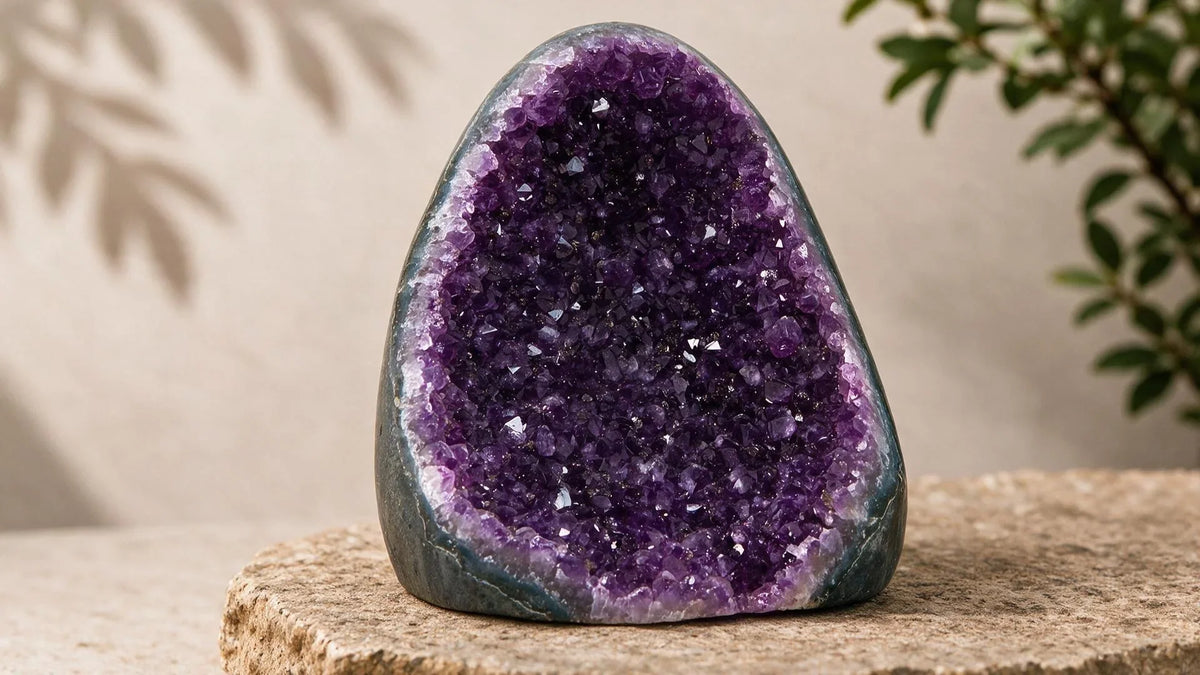
It is a crystal, properly speaking, and that is worth saying plainly because most people assume otherwise once they hold a bead. Quartz normally grows as six-sided prisms with flat faces and a point. Amethyst usually does not. It lines the inside of a cavity, packed tight against its neighbours, and the faces never get the room to form. So it is crystalline in structure and shapeless in hand at the same time.
It forms inside volcanic rock. When lava cools, gas pockets are left behind, and hundreds of thousands or millions of years later, hot water carrying dissolved silica moves through those pockets. The water cools slowly against the cavity wall, and quartz begins to crystallise inward, toward the centre.
It does not happen in one go. A geode is a record of many separate floods. The outermost layer is usually a green celadonite, then a band of chalcedony, then fine-grained quartz, and only at the end, closest to the hollow centre, the large crystals that carry colour. Each layer is a different episode of water at a different temperature. You are not looking at one event. You are looking at a stack of them.
The colour needs three things at once: iron inside the crystal, natural radiation to displace it, and the right position in the lattice for the displaced iron to sit. When all three line up, the iron absorbs yellow-green light and what comes back to your eye is purple.
Which is why the colour is usually at the tips. The iron and the radiation have to be there at the end of the growth, not the beginning. On the same crystal, the base can be colourless quartz and the point can be violet.
Radiation deepens the colour, and heat takes it away. This is not a metaphor; it is the actual mechanism. Gem dealers have known it for a very long time, which is why most of the citrine on the market is amethyst that has been heated until the purple goes.
The cavity cooled over hundreds of thousands of years, one thin layer at a time, and the colour arrived at the very end. A geode is a long cooling written in stone: the quiet after a volcano, slowly becoming something you can hold.
Two facts to finish with. Amethyst is 7 on the Mohs scale, the same as clear quartz, which makes it one of the most forgiving stones we work with. And it is one of the minerals most sensitive to light: leave a deep purple piece in a sunny window for months and it will pale.
Where amethyst meaning comes from
Here is the thing about being carried away: it never announces itself. Nobody decides to lose an afternoon.
It goes like this. A message at four that you answer before deciding whether you wanted to. A conversation at nine that you are still having in your head at eleven. None of it is dramatic, and all of it is somebody else's schedule becoming yours.
Being clear is not the same as being unaffected. It is knowing what is currently taking you, while it is taking you. Most of the time you cannot stop it. But there is a difference between being carried and being carried while aware of it, and that difference is where the choice lives.
And there is a second half, which is where the old story earns its place. Purple appears for a few minutes and then it is gone. The sky does this every evening, without fail, and it has never once stayed. That is not a sad fact about purple. It is the most useful thing about it.
Whatever is happening at dusk will not be happening at midnight. Knowing that is what people usually mean by wisdom, and it is not a mood. It is a piece of information, and it is available every evening for free.
Which is where calm comes from. Not from things being fine. From having watched enough evenings to know that the light always changes, and that the change is not something you have to arrange.
Two pieces
Both of our amethyst bracelets are that colour, at the hour it belongs to.
Nocturne is a nocturne, which is a smaller thing than it sounds. The form was not written for concert halls. In the Romantic period it was a piece of intimacy, a reverie for one person at a piano, and Chopin, who was never comfortable in front of a large audience, wrote twenty-one of them.
They share a shape: a quiet opening, a middle that becomes agitated, and then a return to the calm it started in. That is not a description of a piece of music. It is a description of an evening.
We use the paler stones here rather than the deepest ones, for a reason about light rather than taste. A saturated purple needs daylight to show what it is doing; in a dim room it goes flat and reads almost black. A pale one holds its colour after dark, and after dark is when an evening actually happens.
The Quiet Sanctuary takes its word from the innermost room. Sanctuarium in Latin means the holiest part of a temple, and it does not refer to the building. It refers to the one place inside it that most people never entered.
That is the intention here, and it is why this is the only bracelet we make that we do not put on the front page. It is not a piece for being seen in. It is 7 on the Mohs scale and built like everything else we make, but it is the one we would describe as private: the same colour as Nocturne, at the hour when nobody is asking anything of you.

Two bracelets, one colour, two hours of the same evening. One closes, one shelters. Both are in the amethyst collection, where the two hours sit beside each other.
Questions
What is the meaning of amethyst?
The name is Greek, and its meaning is simply not drunk. Everything else people have said about this stone for two thousand years is an elaboration of those two words.
Does amethyst fade?
Yes, more than most stones. Amethyst is one of the minerals most sensitive to light. A deep purple piece left in direct sun for months will go paler, and it does not come back. Keep it out of a sunny window and it holds.
Why does amethyst have bands of lighter and darker purple?
Because that is how natural amethyst grows. The colour depends on iron and radiation being present at the end of the crystal's growth, so a single crystal often runs from colourless at the base to violet at the tip. Even colour across a whole strand is usually a sign of treatment, not of quality.
Is most citrine really heated amethyst?
Often, yes. Most citrine on the market is amethyst heated until the purple turns yellow. It is not a defect and nobody is hiding it; it is simply how the material is usually produced.
Is amethyst a birthstone?
Yes, for February. It is also the principal stone of our February set, with kunzite beside it, which makes February the one month where the traditional list and ours agree without any adjustment at all. If you want the whole year at once, the birthstone chart sets all twelve side by side.
Is amethyst rare, or expensive?
Neither, in the way people usually mean it. Fine deep purple is uncommon and priced accordingly, but amethyst as a material is one of the most available coloured stones there is. What is rare is the colour, not the mineral.
Can I wear amethyst on either wrist?
Either. There is no rule in how the stone behaves, and the only practical difference is which hand you use more. Amethyst is 7 on the Mohs scale, so the working wrist is fine.
Does amethyst scratch?
Barely. Amethyst is 7 on the Mohs scale, the same as clear quartz, harder than glass and most metals. It is one of the most forgiving stones we carry. For daily habits and storage, see our crystal bracelet care guide.
Ember Quiet. The ember is what the earth leaves. The quiet is what you do with it.