

Birthstone Bracelets: What a Birthstone Means, and How to Choose One
The pieces that can carry one are in Personalized →
Most jewellery treats a birthstone as a fact you either have or you don't. Your month has a stone, here it is, and the conversation is over. The part that comes before that is more interesting: what the word has meant, why the lists disagree with each other, and how to choose one without guessing.

The piece comes first. The month is what makes it yours.
Nobody arrives at a bracelet like this by accident. You find the piece because of what it carries: The Iron Hawk if the work is happening behind your eyes, The Earth Anchor if you keep losing the ground under your own feet, The Pure Heart if the thing you are trying to get better at is kindness. That is the reason you are here, and the added stone does not replace it.
What the birth month crystal does is put your name on it. Everyone wearing that design is carrying the same stones and the same intention; the one part of the strand that belongs only to you is the month. Adding it does not change what the piece is for. It points the same intention at a person, and the person is you.
Worth saying plainly, because it is easy to expect more: a month crystal is not an upgrade, and it is not a second purpose laid over the first. It is the most direct line there is between you and the thing you chose, because the month is the one detail of your life that the piece can actually name.
What a birthstone is
A birthstone, which we call a birth month crystal, is a stone attached to the month you were born in. It is worth saying plainly that the attachment is a habit rather than a rule. The idea is old; the list is not.
The version most people grew up with has been redrawn more than once in the last century, and it was never fully agreed on. June carries pearl and moonstone. October carries opal and tourmaline. December has three stones, depending on who you ask: turquoise, zircon or tanzanite. Ask two jewellers for your stone and you can get two answers that are both correct.
What has stayed steadier than the list is the colour. People read stones by colour long before anyone wrote a month next to one, and each month's traditional stone has a colour that already reads as that month: the blue-green of March, the water-blue of September, the gold November keeps after the leaves go. So when a stone is chosen for a month here, the colour is the part worth keeping.
None of that is a claim about what a stone does. Nothing here has been shown to change anything for the person wearing it, and what it is worn for is the reminder, not the result.
What "my stone" is actually saying
People describe a birthstone as theirs, and the possessive is doing something specific. It is the one stone in the world that arrives with a date attached — and the date is yours. A stone you chose from a shelf says something about your taste. A birthstone says something about when you arrived. Those are different jobs, and both are honest ones.
It is also why so many birthstone pieces are bought for other people, and why the month does not have to be your own. A month can mean something to a person without being the month they were born in. The month they moved. The month something changed. The month they would rather mark than explain.
Most people meet the idea before they meet the stone, usually as a child, from a list in a book or a shop window. Long before they buy anything, they already have an answer ready. That is worth noticing: a birthstone is rarely a discovery. It is a confirmation.
How to choose one for yourself
Three decisions, in this order.
Start with the piece. It carries the intention, and it stands on its own: it is a finished piece before any month is added to it. Read the few that sound like your situation, and choose the one you would wear even if the month option did not exist. If nothing else is settled, settle that.
Then decide on the month. If you want your own, it is the calendar month your birthday falls in, and there is nothing else to work out. If you want a month with a reason behind it, that is allowed too: the month someone else arrived in, the month you finally stopped, the month only you know about. The piece does not ask, and neither do we.
Then look at the two together. The month stone is an accent rather than a different piece. That is why its colour is worth two minutes before you order, with the product photos on one side and your month's stone on the other.
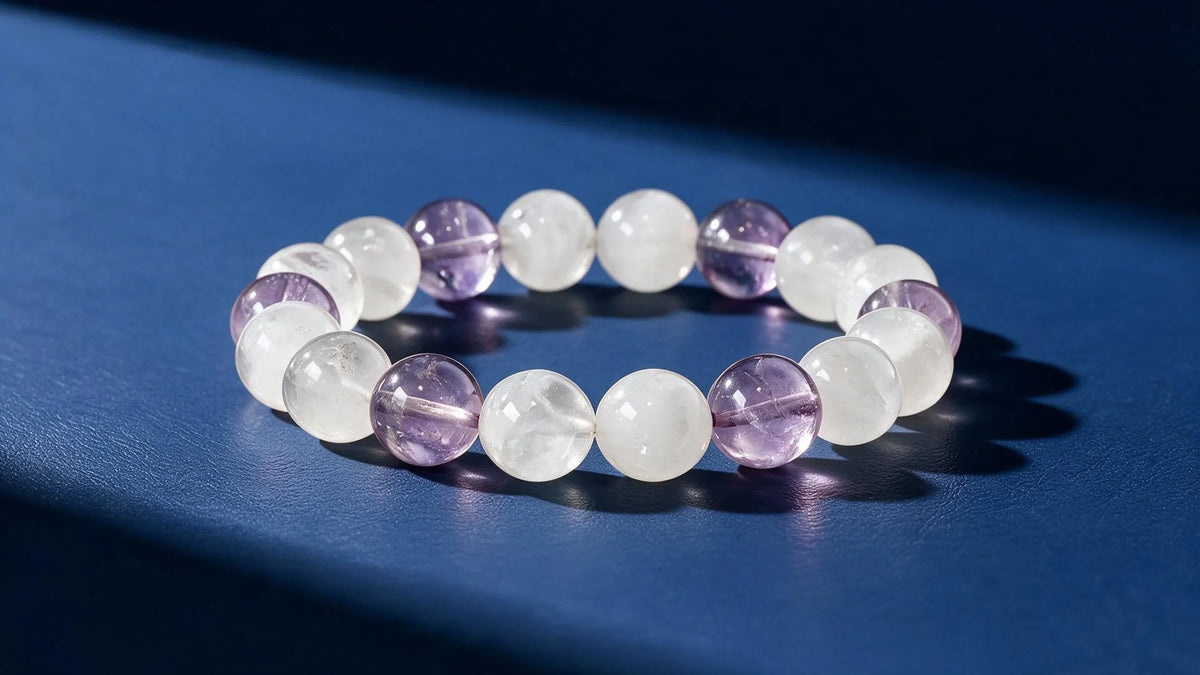
For lighter, translucent strands like The Lover's Moon, a deep birthstone bead provides a grounding anchor. For balanced multi-mineral pieces like The Triple Vision, the added month stone creates a deliberate focal point. For warm golden pieces like The Golden Horizon, an added stone settles naturally into the palette.
Many of these are bought without an occasion. The night it happens is usually an ordinary one, at the end of a week that took more than it gave, and the month gets chosen for what that week was about rather than for a date on a form. Nobody at this end asks why, and nothing here needs explaining.
If you want to see all twelve months at once, and what we use for each, the chart has them side by side.

How to choose one for someone else
Birthstones are unusually good gifts because half of the decision cannot be got wrong. The month is a fact, and facts do not need taste. What needs taste is the piece, and that is where most gift buying goes wrong: people choose the stone confidently and then guess at the design.
So the order that works is to settle the month first, because you can, and then be conservative about everything else. Two people born in the same month can be given very different pieces and both will be right. What makes a birthstone gift land is that the month was known rather than guessed.
Three versions of this, depending on who it is for:
For a partner. You usually know the date, so the month is settled before you start. What you are actually choosing is how much the piece looks like something you picked for them rather than something you bought for an occasion. The month is the reason; it does not have to be the loudest thing about it.
For a friend. It is usually for a stretch rather than for a date. Someone moves cities, or leaves the job that was making them ill, or spends a year not sure what they want next. What makes it work as a gift is that it does not diagnose anything: you are not handing over a bracelet that says you have noticed they are struggling. You are handing over one that says you know which month they arrived in. That is an easier thing to give, and an easier thing to receive.
For someone whose date you would rather not ask for. Use the month that says what you mean, or ask. January for endurance, October for comfort, November for the kind of strength that does not announce itself. It stops being a birthday piece and becomes a message with a stone in it, which is a different object and an equally good one.
If your month's stone isn't the one you would have picked
This happens more often than the guides admit. A colour you do not wear. A stone that has never appealed to you. There are two honest answers, and both are allowed.
The first is that you are not required to use your own month. Nothing in the piece checks the date. If January's garnet leaves you cold, the question becomes which month you would want to carry, and that is usually a month with a reason behind it.
The second is what most people do in the end: they take their own month and choose the piece it suits. A month's stone arrives in whatever colour that month's light has, and that colour is usually quieter than the name of the stone suggests.
One thing worth knowing before you decide, because it is the only part of this that can genuinely surprise you. Every month's stone has its own colour, and it does not sit at the edge of the piece — it goes in the centre of the strand, held between two steel caps. Most months drop into most pieces without anyone noticing a problem. A few pairings are loud: a deep blue month stone in a warm golden strand, a cold green among pinks, that kind of thing. Whether that reads as deliberate or as wrong is a judgement only the person wearing it can make, and it is worth making now rather than after the parcel arrives.
If you are choosing by colour, the safe rule is temperature: warm stones sit easily in warm palettes and cool stones in cool ones. The other move is contrast, which is what the three examples above are doing — one deep stone landing in a pale strand and reading as a decision rather than an accident. Both work, and the pairing worth avoiding is the one in the middle, where two colours are close but not close enough.
If you are choosing by month, the colour arrives with it, and that is the whole of the trade.
What to expect when it arrives
Every stone is an individual. The month stone is a natural crystal, so the shade, the depth and anything inside it will be its own. Two pieces with the same month will not match each other exactly. That is the nature of the material, not a defect in the order.
Colour is the thing to think about. A month stone goes onto a strand that was already finished, and the only question worth asking is whether you want it to sit quietly in that palette or to stand apart from it. Both work; they read differently. If you are unsure, look at the piece you like and imagine one bead of your month's colour in the middle of it.
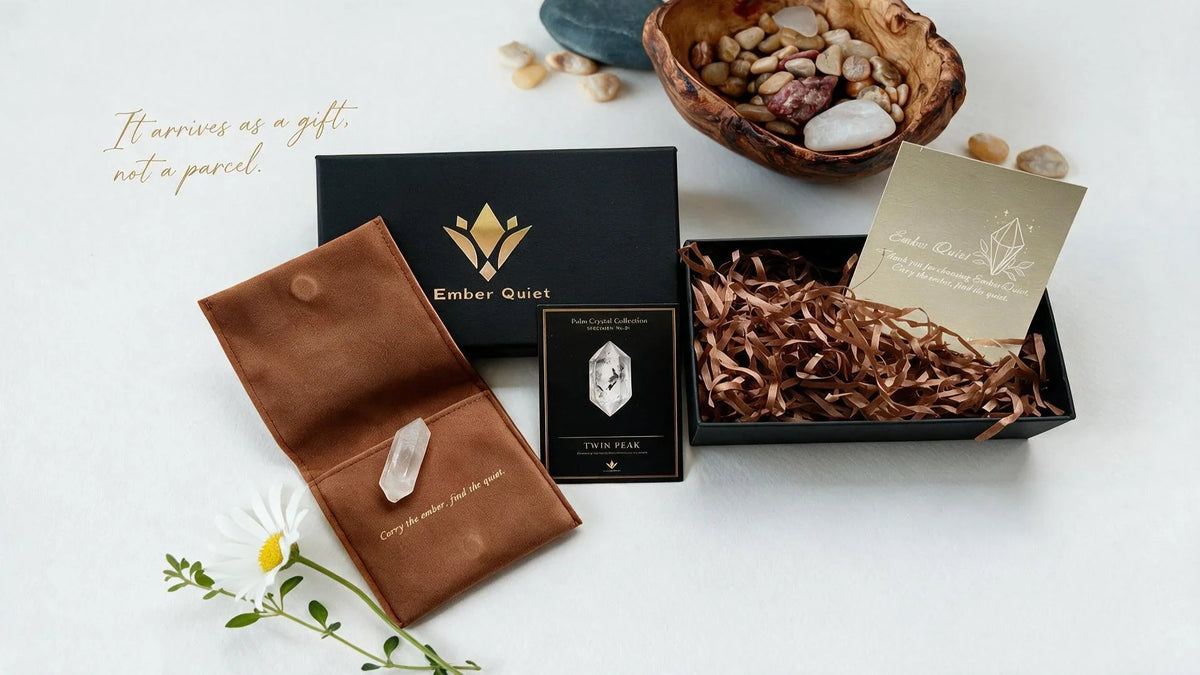
Your piece arrives in our signature Ember Quiet packaging — designed to feel like a gift, not a parcel. Every order includes a keepsake box and a velvet storage pouch, whether you are sending it to someone else or opening it at your own kitchen table.

Three practical things. The stones are hard; the cord is not. Keep the piece out of the shower, the pool and the sea, and put it on after lotion rather than before. Cleaning is a soft dry cloth, not a soak.
Common questions
What does a birthstone bracelet mean?
It means the month you were born in, carried in a stone chosen for that month's colour and light. It is a marker rather than a forecast: the month you arrived, worn where you can see it.
Is it good luck to wear your birthstone?
People have worn one for luck for a very long time, and the luck they describe is quieter than the phrase suggests: something of your own, chosen once, that your hand finds without thinking on a day that is going badly. If that is what you mean by luck, keep the word.
Should the bracelet's own stones be my birth month crystal?
No. The bracelet is the piece you chose, and the added stone is a second thing sitting beside it. The two do not have to agree, and often they do not.
What does the added birth month crystal cost?
Two dollars on top of the piece, and nothing else about it changes.
Which pieces can carry a birth month crystal, and where do I choose the month?
Two things happen on the product page: you pick the piece first, then you pick the month. It appears as Add Your Birth Month Energy Crystal, and it is available on the pieces that can carry one.
What if I'm not sure which month looks right on the piece I chose?
Tell us which piece you are looking at and we will tell you which months sit quietly in it, or whether the one you have in mind works.
What if I don't know their birth month?
Use the month that says what you mean, or ask. A birthstone gift that arrives with the right month and the wrong reason is still a gift. The reverse is a story they will tell for years.
How do I look after it?
The short version is water, sun and storage. Brief contact with water is fine, soaking is not, and the cord inside a bracelet ages long before the stone does. The full version is in our crystal bracelet care guide.
Where this fits
Each month has a longer piece of writing behind it: what the month is like, where it sits in the year, and the stone itself. They are gathered together in The Ember Year.
All of these pieces are gathered in our personalized birthstone collection, where each customizable strand is described in full.