
The Eight Forms of Double-Terminated Quartz (and How to Tell Them Apart)
If you've read The Stone That Grew With No Anchor, you already know the basics: it grows without ever attaching to bedrock, which is the only way a crystal ends up with a point on both ends. That's the how.
What that article didn't cover is the what — what these stones actually look like when they come out of the ground.
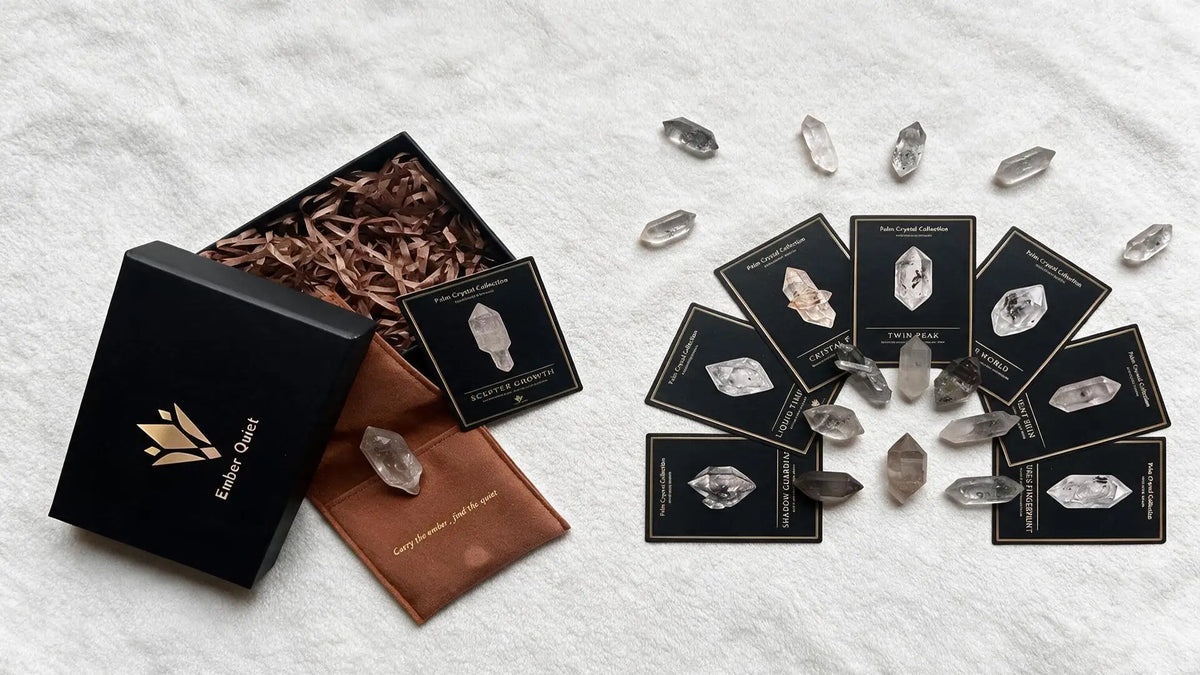
Because they don't come out in one shape. They come in eight. Not eight rigid categories we invented for a product page, but eight distinct expressions the earth leaves on a crystal that was never held in place. Each one is numbered, and each one gets a card naming the form it turned out to be.
Here they are, with what to look for in each.
How one stone ends up in eight different shapes
Ordinary quartz grows attached to something — a cave wall, a vein, a cluster. One end is rooted, one end is free, so the crystal only ever forms a point at the free end. A double-terminated quartz grew floating in a pocket of soft clay, held steady by the material around it and attached to nothing. Both ends were free, so both ends became points.
That part is constant. Everything else came from the specific conditions of that one pocket, in that one place: the size, the clarity, whether it grew alone or with others, what got trapped inside, what its surface looks like after millions of years.
Same process, eight different outcomes.
The Geometry: Eighteen Natural Faces
Before looking at individual forms, there is a piece of quiet magic shared by every single double-terminated stone: count the faces, and you will find eighteen.
Six prism faces running down the central body, and six pyramidal facets meeting at each of the two tips — eighteen planes in total. No stonecutter cut them; no polishing wheel shaped them. Nature achieved perfect crystalline geometry entirely on its own through time and pressure.
Regardless of what form your stone takes — whether it holds ancient water, deep mineral inclusions, or an unpolished skin — those eighteen natural facets are always there. (And in clustered formations like 002 Crystal Family, where multiple crystals grew intertwined, the number of facets multiplies even further). If you hold the stone in your palm and turn it slowly under a direct light, catching the reflection face by face, you can count every single one. It takes a little patience, but the earth spent millions of years carving them; they reward the time.
The Eight Forms
A vital truth about these stones: these attributes do not exist in isolation.
Nature does not work from a checklist. Having two points is the inherent, foundational attribute of every single double-terminated quartz — it is the baseline of what this mineral is. From there, nature combines traits at will: a crystal can be an enhydro with internal minerals (004 with 003), a scepter with ancient skin (005 with 006), or an intertwined cluster cloaked in dark earth (002 with 008). They are fluid, living combinations. That is why no two stones are ever identical.
When we name a stone's form on its card, we are naming its most prominent chapter. Here is how to understand each one:
001 · Twin Peak

The foundational archetype — two clean points from a single origin, reaching in opposite directions without ever losing its center.
How to spot it: two clean tips, unobstructed clarity, nothing extra. While double-terminated quartz as a mineral is far rarer than common quartz due to its demanding pocket formation, within this stone, the dual point is the universal standard. 001 represents the crystal in its purest, unadorned state: no secondary cluster, no heavy inclusions, no scepter crown. Just the primal geometry itself.
002 · Crystal Family

Two or more crystals that grew from the same origin, their forms intertwined over millions of years. They did not compete for space — they made room for each other. A reminder that growth is not always a solitary journey.
How to spot it: you can see where one crystal pressed against another. They weren't clustered after the fact; they grew that way, side by side, in the same pocket.
003 · Inner World

Minerals, liquids, and ancient matter became trapped within the crystal as it formed — frozen in place before the world above them even existed. What you see inside is not an impurity. It is a memory.
How to spot it: hold it to the light and look for structure inside — layers, shapes, small dark forms. No two contain the same things.
004 · Liquid Time Capsule

Look closely. Tilt it. Turn it upside down — and watch. A tiny fragment drifts slowly through water that has been sealed inside for millions of years. That movement is real. That water is ancient. You are holding the oldest water you will ever touch.
How to spot it: this is the one that never shows up in a product photo. Tilt the stone under a direct light and look for a small bubble with movement in it.
005 · Scepter Growth

Growth paused. Then began again — this time wider, more deliberate, forming a crown over what came before. The interruption is visible, and it is the most important part of the story. It did not stop. It continued.
How to spot it: the new growth is wider than the old. You'll see a base section, a clear step out, then a wider crown above it.
006 · Ancient Skin

The surface bears the marks of the earth's own friction — rough, stripped of shine, shaped by forces no human hand could replicate. Beneath it, the energy remains intact. This is a geological record written on the outside. This crystal did not observe the earth's transformation. It lived through it.
How to spot it: no polish, no gloss, rough to the touch — more like stone than glass. It doesn't photograph as cleanly as the others, and it's usually the one people who've handled a lot of crystals reach for first.
007 · Nature's Fingerprint

Etchings and patterns carved naturally into the surface over millions of years — no two alike, no tool involved. The earth marked this crystal the way time marks everything it touches: slowly, precisely, and without asking permission.
How to spot it: deep structured lines running across the faces. Not cracks, not damage — they follow a pattern, and that pattern belongs to one stone only.
008 · Shadow Guardian

Its deep gray-black tone comes from mineral inclusions absorbed during formation — iron, carbon, ancient earth. It did not become dark by accident. It absorbed what surrounded it and grew stronger for it. This is not shadow. This is armor.
How to spot it: almost no light passes through. It reads as a solid dark shape rather than a clear one — the easiest of the eight to identify.
How to tell them apart at a glance
Look at the ends first. Both pointed, nothing broken? You're holding a double-terminated crystal. If it's clean and clear with nothing else going on, you're looking at 001.
Then look inside. Clear with structure or dark mineral forms → 003. A moving bubble → 004. Uniformly dark throughout → 008.
Then the surface. Rough, matte, and unpolished → 006. Deep geometric lines and etchings → 007.
Then the growth structure. A wider crown over a narrower base → 005. Two or more crystals grown together → 002.
Because nature combines these traits freely, you may find a stone carrying more than one story — a moving water bubble inside an etched crystal, or dark minerals trapped under an ancient skin. Look closely to see every layer the earth gave it.
Frequently asked questions
Are these the same as Herkimer diamonds?
Herkimer diamonds are double-terminated quartz from one specific region in New York State, and that name only applies to stones from there. Ours come from other sources. Same mineral, same formation process, different origin. We go into the name, and what these stones mean, in Double-Terminated Quartz: Meaning and Traditional Benefits.
Can I request a specific form?
No. We can't tell the earth what to make. The stone that arrives with your order is the one set aside for it — chosen by hand, not by category.
Are the rarer forms more valuable?
We don't grade them or price them separately. Every form took the same conditions and the same amount of time in the ground. Which one is "better" depends on which one you'd rather hold.
Which form is the rarest?
Liquid Time Capsule — a stone with water sealed inside. They don't come often, and even when one does, you can miss it: the particle drifts with the water instead of sitting still, so it takes a moment of tilting the stone under good light to find.
Twin Peak looks like the rarest of the eight, and it isn't. Double-terminated quartz as a mineral is genuinely rare compared to ordinary crystals because of how it forms — but among double-terminated stones, having two clean points is the baseline configuration, not a rarity. It only feels rare because almost every crystal people have held grew anchored to bedrock and never formed a second point.
How do I look after it?
The single most important rule for any double-terminated quartz is protecting it from drops and hard knocks. Because these crystals are sharply defined and naturally faceted at both ends, a fall onto tile, stone, or hardwood can easily chip or break the delicate points. Handle it mindfully, avoid carrying it loose in a pocket alongside keys or coins, and keep it resting in its soft pouch when not in hand. For everyday care, avoid soaking or harsh cleaners — a soft, dry cloth is all it needs.
Here's the part we can't do anything about.
We don't sell these stones. One comes with every order of $75 or more, chosen by hand, numbered, with a card naming which of the eight forms it turned out to be.
You don't get to pick which one. Nobody does — not you, not us. What arrives is what the earth made, and the form is simply the record of how it made it. Explore Earth Forged to see the stones up close.
Some people get 004 and find water inside. Some get 008 and a black stone. Some get a combination of three different traits in a single piece. Same mineral, same millions of years, and neither one is better.
No two numbers repeat, because no two stones do.