
Double-Terminated Quartz: Meaning, Traditional Benefits, and How to Work With One
I found my first one on a hike I almost didn't take, one that wasn't in the plan.
At that point in my life I was wound tight. Work and life had me rehearsing problems that hadn't happened yet, spending the good hours of the day on a future that never arrived. I didn't have a word for it. I just knew the inside of my head had gotten loud.
The crystal was half out of the ground, sitting in the open. My first reaction wasn't spiritual. It was: how is this real? A point on both ends. Nothing broken off, nothing cut. It looked finished, and nobody had touched it.
For a long time, nothing happened. I put it on my desk. It sat there.

But on the days when the room felt too small, I'd pick it up and run my thumb along the edges and the facets. It was so plainly old. Feeling how it had been made quieted things down for me.
The change wasn't instant, and it wasn't dramatic. It didn't change me. It just stayed. Quiet company, in the moments I needed it.
We've found others since. Bigger ones, better-looking ones. But that one is itself. My stone.
What follows is what I've learned about what this crystal actually is.
What "double-terminated" means
Quartz often grows attached to a rock or another crystal, with a point at its free end. A double-terminated quartz has a natural point at each end — which means it grew as a free crystal in a pocket where both ends had room to develop.
We went through the formation in more detail in The Stone That Grew With No Anchor.
What it means in crystal tradition
Here is the honest version. In crystal tradition, double-terminated quartz isn't assigned one quality. Rose quartz is often associated with love, citrine with abundance, amethyst with clarity. This one doesn't get a single word. It's described as a stone that moves in two directions at once, taking in and giving out, and working with whatever is near it.
That's why you'll see it described as a universal stone rather than a stone for one purpose. It isn't the specialist in a collection — it's the one that works with the rest of it.
Why people call it an amplifier
In crystal tradition, the two points are understood as energy moving in both directions, in and out at once. That's where the amplifier idea comes from — and the way it's usually put is that it works with what's already there rather than adding anything new.
Which is why it's a stone you pair, rather than one you use instead of something else.
What people keep one for
- To hold a direction. Write down what you're aiming at, and keep the stone beside the note — a visible reminder rather than something in a drawer.
- To sit with other stones. Some people place it among the crystals they already keep, rather than in place of them.
- To slow down before a decision. Hold it and turn it slowly while you take a moment.
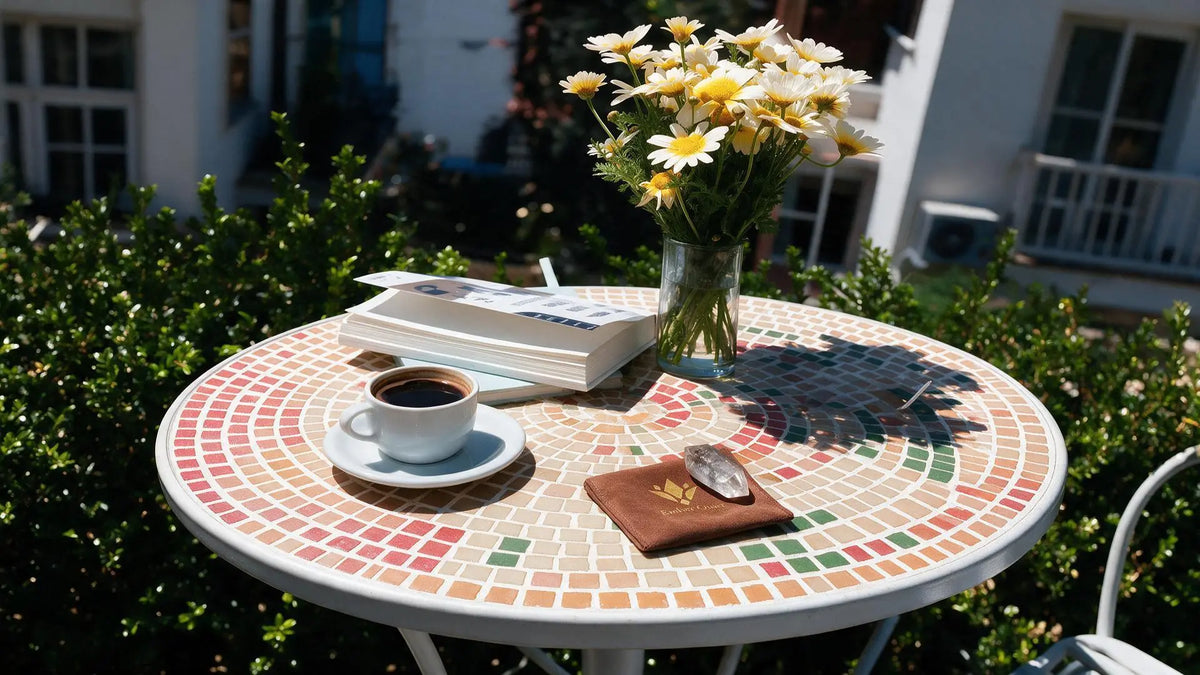
- To carry. It fits in a pocket or a palm. This is what a pocket crystal is — not a smaller category, just the one that comes with you. In its pouch, it goes anywhere.
How to work with one
WHEN · The moments that ask for a pause. Before a hard conversation. The start of a day. When the same thought keeps circling.
HOW · Hold it. Turn it slowly under a light. It isn't a ritual you have to get right — the point is the slowing down.
WHERE · A desk, a nightstand, a pocket, or with the rest of your stones.
The pocket is the one worth saying more about. A stone on a shelf is easy to forget; the one you carry is the one you actually hold. In crystal tradition that's most of the reason to keep one on you — two points, energy moving in both directions, working with you through the day rather than sitting still.
Some people carry one every day; others take it out for the moments that ask for a pause. Both are how it gets used — and the first is why it's this size.
Not every double-terminated quartz is a Herkimer diamond
Search for these stones and you'll often find one name: Herkimer diamond.
Herkimer is a place. The name belongs to naturally double-terminated quartz found around Herkimer County, New York, where they've been dug out of dolomite since the eighteenth century. Despite the name it isn't a diamond — it's quartz. The most prized ones are clear, sharp at both ends, and often hold something inside: dark anthraxolite, or a pocket of ancient water that shifts when you tilt the stone.
Every Herkimer diamond is double-terminated quartz. Not every double-terminated quartz is a Herkimer diamond.
We don't sell these stones — the ones that go out with our orders are called double-terminated quartz, not Herkimer diamonds, because we can't claim they come from Herkimer County. It's also most of the reason two stones with a similar shape can differ so much in price.
The eight forms, and why yours comes with a card
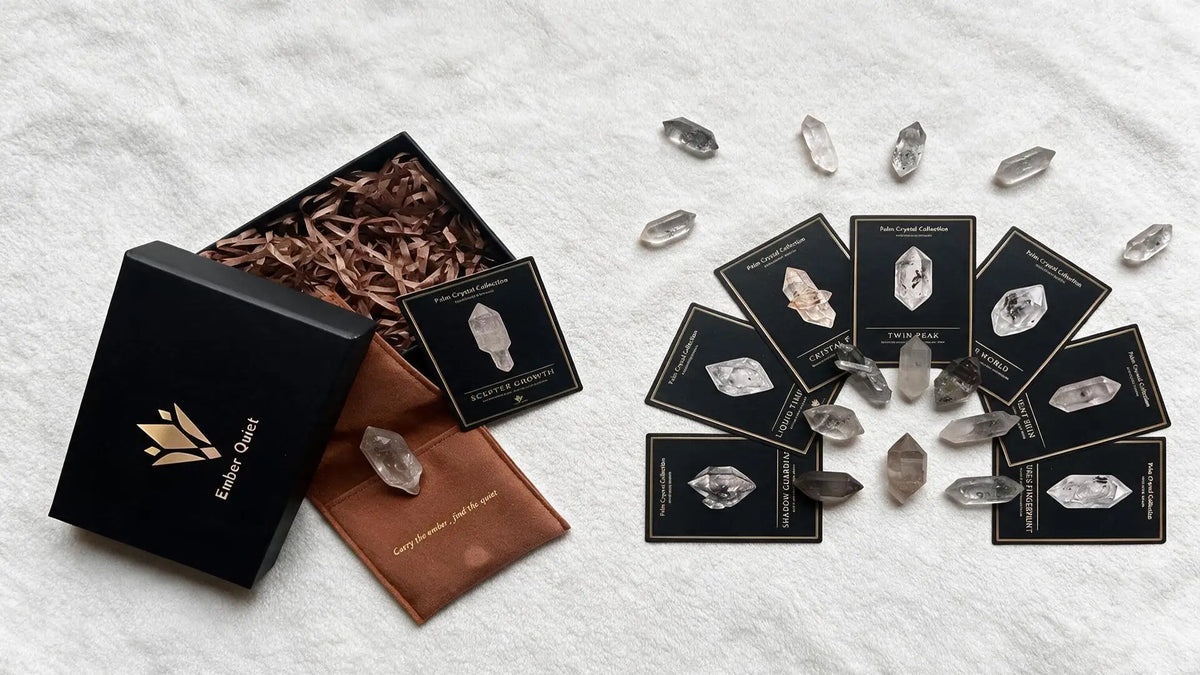
Every stone comes out of the ground with its own combination of traits: how clear it is, whether it grew alone or with others, what got trapped inside, and what its surface looks like. The eight names we use, Twin Peak, Crystal Family, Inner World, Liquid Time Capsule, Scepter Growth, Ancient Skin, Nature's Fingerprint, and Shadow Guardian, describe a stone's most prominent feature. They aren't eight boxes nature sorts itself into.
One comes with every order of $75 or more, chosen by hand, numbered, and accompanied by a card naming its form. No two numbers repeat. You can see what to look for in The Eight Forms of Double-Terminated Quartz, or browse the Earth Forged collection.
Why we leave them as they came out
Most stones that live in a pocket have been shaped first. A worry stone is a flat stone, polished smooth, sometimes with a groove for a thumb; some are engraved with a single word. All of that happens to the stone after it comes out of the ground.
A double-terminated quartz arrives finished — two points, natural facets, a surface that took millions of years to reach. Polishing it would mean removing the only part of it that can't be remade.
The points can chip, though, so keep yours in its soft pouch rather than loose with keys or coins. A fall onto a hard floor can take a tip off.
Frequently asked questions
Is a double-terminated quartz a Herkimer diamond?
Only if it comes from the Herkimer County area of New York. Herkimer diamonds are quartz, but the place name doesn't apply to every double-terminated specimen.
What does a double-terminated quartz do?
In crystal tradition, it's described as a stone that works with what's around it rather than for one purpose: two points, energy moving in both directions. It's usually kept with other stones, or carried, rather than used on its own.
Where should I keep mine?
Anywhere you'll actually see it — a desk, a nightstand, or alongside other stones.
Can I carry it with me every day?
Yes. It's sized for a pocket or a palm, and the two points are the only part that needs looking after — in its pouch it can go everywhere with you. Some people keep it in a pocket all day; others take it out for the moments that ask for a pause.
How do I look after it?
Keep it in its pouch when it isn't in your hand. Protect both points from hard knocks. Wipe it gently with a soft, dry cloth; avoid soaking it or using harsh cleaners.
My first one is still on my desk. It isn't the biggest or the clearest stone we've found since, and it never will be.
It didn't change my life. It stayed with me through it.
My hope is a small one: that you find a minute of quiet somewhere in your day.